 Welcome to the 19th article in this absurdly long and pedantically detailed series on Penal Substitutionary Atonement (PSA). You can read the intro article to catch up if you’re just joining us and have a lot of time on your hands to read all the research.
In the previous article, we examined “justification” and what “clothed in the righteousness of Christ” means, and capped that off by looking at PSA’s 4th pillar. This time, we’ll look at the Early Church Fathers and see if they taught PSA.
An important disclaimer first:
We spent the last 18 articles defining PSA and examining if it was true; please see those articles for that research. However, that’s not the point of this article.
This article is not about if PSA is true; it’s about whether the early church fathers thought it was true.
There’s a difference, and please keep that difference in mind as you read. But before we dive in, there’s some important context to cover first.
Methodology and context
Many people who make content about PSA — both for and against — rely on secondary sources for their information. That is, they read the scholars who have actually read the early church fathers and use their summaries in their arguments. There’s nothing necessarily wrong with that, but it does require a level of trust in the scholars. After everything we’ve seen in this series, I don’t have that trust anymore. I’m not even claiming willful deception. As we’ve seen, it can often simply be bias creeping in.
Thus, I didn’t go to the secondary sources.
I went to the primary sources.
I read the early church fathers’ writings themselves. And I didn’t just read the section quoted, nor even just the chapter quoted, I read all of every document that every single quote came from.
Every.
Single.
One.
(Well, all but 2 because I couldn’t find a source for them. Don’t ask how long that took. I will say that I started writing this article before I published the intro article though…)
I started reading the primary sources because during my research, I discovered that one side of the debate regularly didn’t include relevant context from the rest of the work. That was the moment I realized a full read-through of their works would be required to get the context right. Sometimes, there’s just no substitute for sitting down and doing the work. (That’s why I don’t publish articles as often as I would like; doing the work takes time.)
Another point about the methodology: I didn’t go and read every other work that these church fathers wrote, nor read everything written by the early church. I’m only one man and I just don’t have that kind of time. However, I did engage with all of the strongest pro-PSA quotes that I could find. While this isn’t exhaustive, I think it would be reasonably representative because if there were stronger pro-PSA quotes, I would expect them to be widely circulated by those who believe PSA.
Thus, while the quotes in this article aren’t an exhaustive study of the early church fathers (nor are they intended to be), they quite likely — but not certainly — include all the strongest pro-PSA quotes. Obviously I can’t be sure of that without reading everything they wrote. However, I think that if PSA believers had stronger quotes, they would cite them. So again, this article isn’t exhaustive, but I think it is representative.
Now, there’s two more bits of context before we get to the quotes.
When “for” doesn’t mean substitution
English words can have more than one meaning, and my favorite example of this is the word “fair”. You could say all of the following using the same word:
- She has fair skin (meaning pale)
- We’ll have fair weather (meaning good)
- He plays a fair game (meaning he doesn’t cheat)
- He plays a fair game (meaning he’s reasonably good)
- We’re going to the fair (meaning an outdoor temporary/mobile amusement park)
- That’s fair to say. (meaning it’s accurate)
It’s the same with the English word “for.” We went through this in some detail in the 14th article of this PSA series, but I’ll recap here, though without evidence because we’ve already been through it. (See that article for details.)
Greek has two (relevant) words that we translate “for”. They are:
- “ὑπέρ” (huper), meaning “for the benefit/sake of” or “concerning”
- “ἀντί” (anti), meaning “in exchange for” or “in the place of”
Importantly, “ὑπέρ” (huper) cannot mean “in exchange for” or “in the place of”. We examined this in great detail in the 14th article, so please see that article for the details and evidence.
When you see “for” in an English translation, you need to know if we’re looking at “ὑπέρ” (huper), or “ἀντί” (anti).
This applies to the Bible and to the Early Church Fathers.
(Note: you can use the Biblehub interlinear Bible to check which it is. I have a whole article that can help with that.)
In the Bible, every time you see a verse that says “Christ died for the ungodly” or something similar, it’s always “ὑπέρ” (huper) meaning “for the sake/benefit of”, never “ἀντί” (anti) meaning “in exchange for” or “in the place of”. We’ll pay attention to this in the Early Church Fathers as well, because it’ll become important fast.
Please keep that in mind, because it’ll come up regularly.
If you assume that “for” means substitution or exchange when “ὑπέρ” (huper) is translated simply as “for”, you will misunderstand the early church fathers. This is true of the Bible as well.
And to be clear, this probably isn’t even intentional by the translators. It’s more likely a result of a desire to avoid a wordy translation than theological bias, either intentional or unintentional. It could also be that the translators think the meaning is obvious, or other reasons as well.
Again, please keep this in mind.
Substitution Doesn’t Necessarily Mean Penal Substitution
One of the hardest things to do when looking into a topic is to set aside preconceived biases, or our “theological lenses”, and this is true of me the same as anyone else. It’s incredibly easy to assume that certain words or phrases mean something that the original author didn’t necessarily intend.
We looked at this several times before in this series, most notably when we looked at Athanasius and his understanding of why Jesus died. As a reminder, Athanasius held a view of substitution that wasn’t penal substitution, and we’ll see the quotes for that (again) soon. At no point does Athanasius say that Jesus’s death was motivated by God’s justice, or wrath against sin, or anything like that. That’s substitution that isn’t penal substitution. If you assume PSA whenever the idea of exchange is mentioned by the Early Church Fathers, you’ll likely misunderstand them.
Some PSA fellows say that they only need to see elements of penalty or substitution to establish that the early church fathers taught PSA. However, we actually need to see elements of penalty and substitution for it to be PSA.
You need both for PSA.
Not merely one or the other, you need both, because without both, it isn’t PSA. That fact is actually embedded in the name itself: Penal Substitution. Thus, without both, it isn’t PSA.
With that context established, we’ll look at the quotes next.
The Quotes
All of these quotes come from Mike Winger’s video about the early church fathers and PSA, since it was the largest concentration of Early Church Father quotes on the topic that I could find. He managed to get all of the popular ones, and virtually all the less popular ones too. You can also download his notes with all the quotes on the Bible Thinker website, link here.
I also picked this source because Mike Winger is pretty well known, and so people regularly consume his content and will reference it. Thus, it seemed like a good source to engage with.
We’ll mostly go through them in the same order that Mike Winger quoted them, with one exception. I want to frontload with a quote that shows an early understanding of Christ’s work on the cross that involves substitution, but isn’t penal substitution. That’ll become important, which is why we’ll look at it first.
Athanasius, De Incarnatione Verbi Dei (On the incarnation of the Word)
There is definitely an element of substitution in this quote, and in the work at large. However, completely absent is any idea of punishment from God, as we saw previously in this series when we looked at his view in brief.
Here’s the quote as Mike Winger presents it:
Thus, taking a body like our own, because all our bodies were liable to the corruption of death, He surrendered His body to death in place of all, and offered it to the Father. This He did out of sheer love for us, so that in His death all might die, and the law of death thereby be abolished because, having fulfilled in His body that for which it was appointed, it was thereafter voided of its power for men. This He did that He might turn again to incorruption men who had turned back to corruption, and make them alive through death by the appropriation of His body and by the grace of His resurrection. Thus He would make death to disappear from them as utterly as straw from fire
The phrase “in the place of” that I highlighted is indeed “anti”, so “in the place of” is a perfectly reasonable translation. Again, the idea of substitution is definitely present there. No question about that at all. However, it’s not penal substitution at all, and in fact comes from a completely different source.
Now, the quotes below were pulled from various portions of the work, and I picked them because they seemed to represent his overall opinion. I do recommend that you read the whole work for more context, but I think the excerpts below accurately summarize the opinion of the work.
Now this is that of which Holy Writ also gives warning, saying in the Person of God: “Of every tree that is in the garden, eating thou shalt eat: but of the tree of the knowledge of good and evil, ye shall not eat of it, but on the day that ye eat, dying ye shall die.” But by “dying ye shall die,” what else could be meant than not dying merely, but also abiding ever in the corruption of death?
…
For death, as I said above, gained from that time forth a legal hold over us, and it was impossible to evade the law, since it had been laid down by God because of the transgression, and the result was in truth at once monstrous and unseemly. firstly, that God, having spoken, should prove false—that, when once He had ordained that man, if he transgressed the commandment, should die the death, after the transgression man should not die, but God’s word should be broken. For God would not be true, if, when He had said we should die, man died not
…
So, as the rational creatures were wasting and such works in course of ruin, what was God in His goodness to do? Suffer corruption to prevail against them and death to hold them fast? And where were the profit of their having been made, to begin with? For better were they not made, than once made, left to neglect and ruin. For neglect reveals weakness, and not goodness on God’s part—if, that is, He allows His own work to be ruined when once He had made it—more so than if He had never made man at all. For if He had not made them, none could impute weakness; but once He had made them, and created them out of nothing, it were most monstrous for the work to be ruined, and that before the eyes of the Maker. It was, then, out of the question to leave men to the current of corruption; because this would be unseemly, and unworthy of God’s goodness. But just as this consequence must needs hold, so, too, on the other side the just claims of God lie against it: that God should appear true to the law He had laid down concerning death. For it were monstrous for God, the Father of truth, to appear a liar for our profit and preservation. So here, once more, what possible course was God to take? To demand repentance of men for their transgression? For this one might pronounce worthy of God; as though, just as from transgression men have become set towards corruption, so from repentance they may once more be set in the way of incorruption. But repentance would, firstly, fail to guard the just claim of God. For He would still be none the more true, if men did not remain in the grasp of death.
…
Thus, taking a body like our own, because all our bodies were liable to the corruption of death, He surrendered His body to death in place of all, and offered it to the Father. This He did out of sheer love for us, so that in His death all might die, and the law of death thereby be abolished because, having fulfilled in His body that for which it was appointed, it was thereafter voided of its power for men. This He did that He might turn again to incorruption men who had turned back to corruption, and make them alive through death by the appropriation of His body and by the grace of His resurrection. Thus He would make death to disappear from them as utterly as straw from fire.
The concern of Athanasius wasn’t God’s justice, it was God’s goodness and His character. Athanasius seemed to believe that God’s goodness wouldn’t allow man to remain in his fallen state. Additionally, and seemingly more concerning for Athanasius, was that since God decreed that man would die if he ate of the tree, if man didn’t die after eating from the tree, God would be a liar.
Effectively, according to Athanasius, God’s goodness wouldn’t allow us to remain fallen, and His truthful character wouldn’t allow Him to let us not die after saying we would die if we ate, for then he would be a liar. Thus, according to Athanasius, Jesus died in our place (substitution) so that he could taste death for everyone who is “in Christ”, and thus ensure that God didn’t become a liar by making us die via being “in Christ”.
Further, he also says: “This He did that He might turn again to incorruption men who had turned back to corruption“, which means part of God’s motive was to “un-corrupt” mankind, purging us from the corruption of sin. We saw the mechanics of this in the 9th article, on what the gospel is and how God saved us.
According to Athanasius, God’s motive wasn’t to punish our sin, but rather, His goodness requiring Him to restore us to life and remove our corruption without becoming a liar.
That is categorically not PSA in any way, shape, or form. In many ways, it’s the opposite because Athanasius thought that Jesus’s death was motivated by love, not justice.
Now, here’s the important part:
In the early church fathers’ writings, Substitution does not necessarily mean penal substitution.
I cannot understate how important this is.
Thus, you simply can’t assume that when you see substitution in the early church fathers, that penal substitution is in view. Given Athanasius’s views on Christ’s work on the cross, there are other options for substitution than penal substitution.
We’ll return to Athanasius later since there are other quotes. However, we’ll tackle the rest of them in the same order that Mike Winger did.
Clement of Rome (c. 95 A.D.)
Here is the quote as Mike Winger presents it:
Because of the love he felt for us, Jesus Christ our Lord gave his blood for us by the will of God, his body for our bodies, and his soul for our souls.
Now, I copy/pasted the Greek text below with a source link. I don’t expect you to read it, but I want to be transparent and I want you to see that the Greek words that I’m saying are being used are indeed the words being used. The red words in the Greek version below are the same words I’ve highlighted in the English version above.
In Greek:
διὰ τὴν ἀγάπην, ἣν ἔσχεν πρὸς ἡμᾶς, τὸ αἷμα αὐτοῦ ἔδωκεν ὑπὲρ ἡμῶν Ἰησοῦς Χριστὸς ὁ κύριος ἡμῶν ἐν θελήματι θεοῦ, καὶ τὴν σάρκα ὑπὲρ τῆς σαρκὸς ἡμῶν καὶ τὴν ψυχὴν ὑπὲρ τῶν ψυχῶν ἡμῶν.
Again, we spent significant time defining the Greek word “ὑπὲρ” (huper) in the 14th article. “ὑπὲρ” (huper) is the word used here and it indicates benefit, not substitution. Here’s that quote again, modified to include this understanding.
(Modified)
Because of the love he felt for us, Jesus Christ our Lord gave his blood for our benefit by the will of God, his body for the benefit of our bodies, and his soul for the benefit of our souls.
Now, do you see penalty or substitution in that longer and wordier, but more accurately translated quote?
Me either.
Again, a significant number of these quotes rest on making “huper” mean “in exchange for”, which it categorically does not mean.
So, whenever you read an early church father quote that appears to support PSA, notice if the word “for” figures prominently. If it does, it’s almost certainly the Greek word huper (or a similar word we’ll cover in a minute) because that’s how the Bible uses huper. Again, all of the “Jesus died for us” passages are huper.
Now, if the definition of “ὑπὲρ” (huper) wasn’t enough, we’ll look at something that Clement says elsewhere in the same document:
So, having so many great and glorious examples set before us, let us turn again to the practice of that peace which from the beginning was the mark set before us; and let us look steadfastly to the Father and Creator of the universe, and cleave to His mighty and surpassingly great gifts and benefactions, of peace. Let us contemplate Him with our understanding, and look with the eyes of our soul to His long-suffering will. Let us reflect how free from wrath He is towards all His creation.
The heavens, revolving under His government, are subject to Him in peace. Day and night run the course appointed by Him, in no way hindering each other. The sun and moon, with the companies of the stars, roll on in harmony according to His command, within their prescribed limits, and without any deviation. The fruitful earth, according to His will, brings forth food in abundance, at the proper seasons, for man and beast and all the living beings upon it, never hesitating, nor changing any of the ordinances which He has fixed.
So according to Clement, God is “free from wrath” toward all his creation, including “man and beast and all the living beings upon it“. Now, I disagree about wrath since Romans 1:18 says:
Romans 1:18
18 For the wrath of God is revealed from heaven against all ungodliness and unrighteousness of men who suppress the truth in unrighteousness
Clement mentions judgement other places in the epistle, so don’t assume that he thinks that God never judges. However, the idea of God being “free from wrath” towards “all His creation” is diametrically opposed to Penal Substitutionary Atonement. It’s almost the opposite because PSA rests on the foundation that God’s righteous and just wrath against sin/sinners must be punished.
Further, Clement’s idea of God being free from wrath is stated far more strongly by another early church father, who likely thought God doesn’t judge at all. We’ll get to that quote soon.
This is why context is important.
This is why I read all of every document that all these quotes come from, because I wanted to make sure I didn’t miss anything. Context matters.
Hilary of Poitiers
Here’s the quote Mike Winger used:
It was from this curse that our Lord Jesus Christ redeemed us, when, as the Apostle says: Christ redeemed us from the curse of the law, being made curse for us, for it is written: cursed is every one that hangeth on a tree [Gal. 3:13]. Thus He offered Himself to the death of the accursed that He might break the curse of the Law, offering Himself voluntarily a victim to God the Father, in order that by means of a voluntary victim the curse which attended the discontinuance of the regular victim might be removed
Right up front, there’s a context problem. The quote starts with “It was from this curse”; that’s obviously referring to what came before, which isn’t included in the quote. So, here’s the quote with more context so you can see which specific curse Hillary is talking about.
Now, by the Law, sprinkling was a cleansing from sins; it purified the people through faith by the sprinkling of blood, of which this same blessed David thus speaks: You shall sprinkle me with hyssop and I shall be cleansed ; the Law, through faith, providing as a temporary substitute, in the blood of whole burnt-offerings, a type of the sprinkling with the blood of the Lord, which was to be.
12. Now in view of our repeated, nay our unbroken assertion both that it was the Only-begotten Son of God Who was uplifted on the cross, and that He was condemned to death Who is eternal by virtue of the origin which is His by the nature which He derives from the eternal Father, it must be clearly understood that He was subjected to suffering of no natural necessity, but to accomplish the mystery of man’s salvation; that He submitted to suffering of His own Will, and not under compulsion. And although this suffering did not belong to His nature as eternal Son, the immutability of God being proof against the assault of any derogatory disturbance, yet it was freely undertaken, and was intended to fulfil a penal function without, however, inflicting the pain of penalty upon the sufferer: not that the suffering in question was not of a kind to cause pain, but because the divine Nature feels no pain. God suffered, then, by voluntarily submitting to suffering; but although He underwent the sufferings in all the fullness of their force, which necessarily causes pain to the sufferers, yet He never so abandoned the powers of His Nature as to feel pain.
13. For next there follows: I will sacrifice unto You freely. The sacrifices of the Law, which consisted of whole burnt-offerings and oblations of goats and of bulls, did not involve an expression of free will, because the sentence of a curse was pronounced on all who broke the Law. Whoever failed to sacrifice laid himself open to the curse. And it was always necessary to go through the whole sacrificial action because the addition of a curse to the commandment forbad any trifling with the obligation of offering. It was from this curse that our Lord Jesus Christ redeemed us, when, as the Apostle says: Christ redeemed us from the curse of the law, being made curse for us, for it is written: cursed is every one that hangs on a tree. Galatians 3:13 Thus He offered Himself to the death of the accursed that He might break the curse of the Law, offering Himself voluntarily a victim to God the Father, in order that by means of a voluntary victim the curse which attended the discontinuance of the regular victim might be removed. Now of this sacrifice mention is made in another passage of the Psalms: Sacrifice and offering you would not, but a body have you prepared for Me ; that is, by offering to God the Father, Who refused the legal sacrifices, the acceptable offering of the body which He received. Of which offering the holy Apostle thus speaks: For this He did once for all when He offered Himself up Hebrews 7:27, securing complete salvation for the human race by the offering of this holy, perfect victim.
Well, that sounds like Hillary is actually saying that Jesus rescued us from having to obey the law. Further, there’s a small part of the quote that shouldn’t be missed:
And although this suffering did not belong to His nature as eternal Son, the immutability of God being proof against the assault of any derogatory disturbance, yet it was freely undertaken, and was intended to fulfil a penal function without, however, inflicting the pain of penalty upon the sufferer. God suffered, then, by voluntarily submitting to suffering; but although He underwent the sufferings in all the fullness of their force, which necessarily causes pain to the sufferers, yet He never so abandoned the powers of His Nature as to feel pain.
So, then do we have PSA (Penal Substitutionary Atonement) where the substitute didn’t suffer? That doesn’t make much sense, does it?
Hillary speaks elsewhere on why Jesus died, and again it’s absent any penal function.
(Paragraph 13)
My soul judged of Him as One Who, drawing us upward to partake of His own Divine nature, has loosened henceforth the bond of bodily observances Who, unlike the Symbolic Law, has initiated us into no rites of mutilating the flesh, but Whose purpose is that our spirit, circumcised from vice, should purify all the natural faculties of the body by abstinence from sin, that we being buried with His Death in Baptism may return to the life of eternity (since regeneration to life is death to the former life), and dying to our sins be born again to immortality, that even as He abandoned His immortality to die for us, so should we awaken from death to immortality with Him. For He took upon Him the flesh in which we have sinned that by wearing our flesh He might forgive sins; a flesh which He shares with us by wearing it, not by sinning in it. He blotted out through death the sentence of death, that by a new creation of our race in Himself He might sweep away the penalty appointed by the former Law. He let them nail Him to the cross that He might nail to the curse of the cross and abolish all the curses to which the world is condemned. He suffered as man to the utmost that He might put powers to shame. For Scripture had foretold that He Who is God should die; that the victory and triumph of them that trust in Him lay in the fact that He, Who is immortal and cannot be overcome by death, was to die that mortals might gain eternity. These deeds of God, wrought in a manner beyond our comprehension, cannot, I repeat, be understood by our natural faculties, for the work of the Infinite and Eternal can only be grasped by an infinite intelligence.
Again, there’s no PSA here.
The Epistle of Mathetes to Diognetus
Here’s how Mike Winger introduces the epistle:
The Epistle of diognetus in the 2nd century. This is a second century work that some people believe is one of the earliest examples of Christian apologetics, which is kind of neat. So it also reveals early thinking in regard to Christ’s atonement, so it’s kind of like a text written sort of like defensively to demonstrate the truth of Christianity. Okay this epistle says:
And here’s the copy/paste directly from his notes, and notice that I’ve highlighted whenever “huper” (“for the benefit of”) is translated simply as “for” here. So when you read “for”, it means “for the benefit of”, not substitution.
“when our wickedness had reached its height. . . . He Himself took on Him the burden of our iniquities, he gave His own Son as a ransom for us, the holy One for transgressors, the blameless One for the wicked, the righteous One for the unrighteous.”19 It then goes on to say, “O sweet exchange! O unsearchable operation, O benefits surpassing all expectation! that the wickedness of many should be hid in a single righteous One, and that the righteousness of One should justify many transgressors.”
This is how the quote always seems to appear online. I saw it in a bunch of places while doing research for this article, almost always in the exact same form. It seems like they are all quoting the same original source who condensed the full quote. Everything in this quote comes from the same paragraph, and here it is in Greek so you can see that the Greek word huper is indeed being used.
Notice how much longer it is.
(I don’t expect most people to read this, it’s here entirely for transparency so you can see that the Greek words I say are being used are indeed being used.)
ἐπεὶ δὲ πεπλήρωτο μὲν ἡ ἡμετέρα ἀδιδία καὶ τελείως πεφανέρωτο, ὅτι ὁ μισθὸς αὐτῆς κόλασις καὶ θάνατος προσεδοκᾶτο, ἦλθε δὲ ὁ καιρός, ὃν θεὸς πρέθετο λοιπὸν φανερῶσαι τὴν ἑαυτοῦ χρηστότητα καὶ δύναμιν (ὢ τῆς ὑπερβαλλούσης φιλανθρωπίας και ἀγάπης τοῦ θεοῦ), οὐκ ἐμίσησεν ἡμᾶς οὐδὲ ἀπώσατο οὐδὲ ἐμνησικάκησεν, ἀλλὰ ἐμακροθύμησεν, ἠνέσχετο, ἐλεῶν αὐτὸς τὰς ἡμετέρας ἁμαρτίας ἀνεδέξατο, αὐτὸς τὸν ἴδιον υἱὸν ἀπέδοτο λύτρον ὑπὲρ ἡμῶν, τὸν ἅγιον ὑπέρ ἀνόμων, τὸ ἄκακον ὑπὲρ τῶν κακῶν, τὸν δίκαιον ὑπέρ τῶν ἀδίκων, τὸν ἄφθαρτον ὑπέρ τῶν θνητῶν. 3. τί γὰρ ἄλλο τὰς ἁμαρτίας ἡμῶν ἠδυνήθη καλύψαι ἢ ἐκείνου δικαιοσύνη; 4. ἐν τίνι δικαιωθῆναι δυνατὸν τοὺς ἀνόμους ἡμᾶς καὶ ἀσεβεῖς ἢ ἐν μόνῳ τῷ υἱῷ τοῦ θεοῦ; 5. ὢ τῆς γλυκείας ἀνταλλαγῆς, ὢ τῆς ἀνεξιχνιάστου δημιουργίας, ὢ τῶν ἀπροσδοκήτων εὐεργεσιῶν· ἵνα ἀνομία μὲν πολλῶν ἐν δικαίῳ ἑνὶ κρυβῇ, δικαιοσύνη δὲ ἑνὸς πολλοὺς ἀνόμους δικαιώσυνῃ.
However…
Here’s the full quote in English so you can see what was clipped out. The text in red is what Mike Winger and others quote. The black text is what they leave out.
But when our wickedness had reached its height, and it had been clearly shown that its reward, punishment and death, was impending over us; and when the time had come which God had before appointed for manifesting His own kindness and power, how the one love of God, through exceeding regard for men, did not regard us with hatred, nor thrust us away, nor remember our iniquity against us, but showed great long-suffering, and bore with us, He Himself took on Him the burden of our iniquities, He gave His own Son as a ransom for us, the holy One for transgressors, the blameless One for the wicked, the righteous One for the unrighteous, the incorruptible One for the corruptible, the immortal One for them that are mortal. For what other thing was capable of covering our sins than His righteousness? By what other one was it possible that we, the wicked and ungodly, could be justified, than by the only Son of God? O sweet exchange! O unsearchable operation! O benefits surpassing all expectation! that the wickedness of many should be hid in a single righteous One, and that the righteousness of One should justify many transgressors!
Now, we’ll look at a few of the things that the PSA school doesn’t include in that quote in a moment. First, we need to look at a vital piece of context that’s always left out by the PSA school. The following quote is in the paragraph immediately before the quote above, and it adds some highly illuminating context.
And He has manifested Himself through faith, to which alone it is given to behold God. For God, the Lord and Fashioner of all things, who made all things, and assigned them their several positions, proved Himself not merely a friend of mankind, but also long-suffering [in His dealings with them.] Yea, He was always of such a character, and still is, and will ever be, kind and good, and free from wrath, and true, and the only one who is [absolutely] good; and He formed in His mind a great and unspeakable conception, which He communicated to His Son alone.
That changes things, doesn’t it?
Context is important.
I will assume the best, that Mike Winger and others who quote this are all quoting from someone who did the original clipping on this quote. Mike Winger and others like him are probably guilty of nothing more than trusting a dishonest scholar and not checking the original source. And really, it’s understandable why they trusted the scholar because I don’t think Mike and others would knowingly twist scripture, so they assume scholars won’t either.
Sadly, they turned out to be wrong in this case.
If the foundational premise of PSA is that God’s character demands that he pour out His righteous and just wrath toward sin, then how can this letter argue for PSA when it says that God has no wrath?
I simply don’t see how it’s possible that this letter teaches PSA, given its contents.
Now, we’ll backtrack and look at what was omitted from the quote that PSA supporters use.
- The phrase “nor remember our iniquity against us” was cut out. This is a clear allusion to Ezekiel chapter 18, which we covered many times in this PSA series. The chapter clearly states that a wicked man’s sins “will not be remembered against him” if he turns from his wickedness, with no punishment or sacrifice required. Additionally, the topic of the chapter is how you cannot punish one man for another man’s sins. Obviously, both of those strike at the heart of PSA.
- Notice that Mike Winger’s version of the quote doesn’t include two stanzas: “the incorruptible One for the corruptible, the immortal One for them that are mortal“. All of the “sin” ones were included, but the two that didn’t fit as well were removed, which does skew things a bit. Notably, if all of them are parallel, these two fit far less well with PSA.
- The whole tenor of the passage shifts significantly with the full quote included.
Now add that this letter explicitly states that the author believed that God is “free from wrath”. That statement is diametrically opposed to PSA’s foundational premise that God’s just and righteous wrath against sin must be expressed by punishing sin. I simply do not see how one can argue that this letter teaches PSA when it repudiates PSA’s foundational premise, and alludes to God forgiving sin without punishment or sacrifice. (Ezekiel 18)
Now, PSA school advocates will likely object, since the phrases “He Himself took on Him the burden of our iniquities“, and “O sweet exchange“, and “that the wickedness of many should be hid in a single righteous One” are used. We’ll look at them one at a time.
“He Himself took on Him the burden of our iniquities“
To understand what the epistle meant, we need to look at another early church father who concisely explains what this kind of language meant in the early church. This is Gregory of Nazianzus:
Moreover, in no other way was it possible for the Love of God toward us to be manifested than by making mention of our flesh, and that for our sake He descended even to our lower part. For that flesh is less precious than soul, everyone who has a spark of sense will acknowledge. And so the passage, The Word was made Flesh, seems to me to be equivalent to that in which it is said that He was made sin, or a curse for us; not that the Lord was transformed into either of these, how could He be? But because by taking them upon Him He took away our sins and bore our iniquities.
Athanasius has a longer quote that gets at the same thing. However, we’ll look at it in full lower down, so I’ll wait until then. Many other early church fathers expressed a similar view as well.
Now, I disagree with this interpretation.
We covered what those verses mean in the 14th article (He became a sin offering) and the 15th article (became a curse for us), and again, I think Gregory was wrong. However, in this article, we are not looking to see what’s true; we’re looking to see what the early church fathers thought was true. Whether they are right or wrong isn’t the point; we just care if they believed PSA or not.
The important point is this:
When the early church fathers spoke of Jesus “taking on sin”, or “becoming sin”, or “becoming a curse”, they were referring to the incarnation, not the cross.
Right or wrong (and I think they’re wrong), that’s what they thought.
Thus, “He Himself took on Him the burden of our iniquities“, and “the Word became flesh”, and He “became sin” (actually a sin offering), or “became a curse”; the early church thought that referred to the incarnation. Right or wrong — and again, I think they were wrong — that’s what they thought.
Thus, this doesn’t support PSA.
“O sweet exchange“
Here’s that quote with a little more context:
By what other one was it possible that we, the wicked and ungodly, could be justified, than by the only Son of God? O sweet exchange! O unsearchable operation! O benefits surpassing all expectation! that the wickedness of many should be hid in a single righteous One, and that the righteousness of One should justify many transgressors!
The “exchange” closest to our focus phrase is about the wicked and ungodly being justified: wickedness for righteousness (facilitated by Jesus of course). That seems to be the “exchange” that this epistle is talking about. That doesn’t mean PSA, since literally every theory about how Jesus saves us includes this idea. (Except the Moral Exemplar model, if taken by itself.)
Another very viable option is that this refers to the means by which He saved us, the incarnation. The title of chapter 9 — where this quote is found — is: “Why the Son was sent so late”, so the context is definitely about the incarnation.
Even if we grant substitution, that still doesn’t get us to penal substitution.
Again, Athanasius has an understanding that includes substitution, but it isn’t penal substitution. We saw that above, and have seen it in other articles in this series.
“that the wickedness of many should be hid in a single righteous One“
Frankly, this is reaching for PSA. Virtually every understanding of Christ’s work deals with Him eliminating our wickedness, so this isn’t unique to PSA. If a phrase can fit multiple understandings of how Christ died, then it can’t argue for one of those understandings over the others. This works just as well with the Cleansing Model we saw in the 9th article, or the Recapitulation Model, or the Restored Icon Model, etc.
It’s not unique to PSA, so it can’t really be used to argue for PSA over the other models.
Again, it’s reaching for PSA.
Epistle of Ignatius of Antioch to the Smyrnaeans (c. 107)
Now, there are two versions of this epistle, a shorter one, and a longer one. Here’s the quote that Mike Winger used in his video:
Now, He suffered all these things for our sakes, that we might be saved.
That belongs to the shorter version, and I’ve copy/pasted the entire paragraph of the short version below for context. If you want to read the longer version, click the link at the end of the quote to compare them side-by-side.
Short Version: Now, He suffered all these things for our sakes, that we might be saved. And He suffered truly, even as also He truly raised up Himself, not, as certain unbelievers maintain, that He only seemed to suffer, as they themselves only seem to be [Christians]. And as they believe, so shall it happen unto them, when they shall be divested of their bodies, and be mere evil spirits.
Now, we’ll look at the Greek of just the bit Mike quoted:
Ταῦτα γὰρ πάντα ἔπαθεν δι’ ἡμᾶς, ἵνα σωθῶμεν·
Again, I’ve highlighted the same word in all these quotes. It’s the Greek word “διά” (dia), which often loses the final character to become δι’, as in the example above. (Rather like how “an” loses the final “n” sometimes; for example: “an owl” versus “a book”. Greek has analogous grammar rules for some words)
Note: the middle definition below doesn’t touch on this verse, but it will touch on a future verse.
διά (“written δἰ before a vowel, except in proper names and 2 Corinthians 5:7; Romans 8:10″ Tdf. Proleg., p. 94), akin to δίς and Latindis in composition, properly, denoting a division into two or more parts; a preposition taking the genitive and the accusative. In its use the biblical writers differ in no respect from the Greek; cf. Winer‘s Grammar, 377ff (353ff); 398 (372)f
…
2. of the reason or cause on account of which anything is or is done, or ought to be done; on account of, because of;
…
διά with the accusative of a person is often equivalent to for the benefit of (English for the sake of)
Now, it’s used with the accusative of a person in the quote — the word “our” is obviously referring to people and is in the accusative case — and thus the proper understanding according to the lexicon is “for the benefit of”, or “for the sake of”.
Notice that the idea of substitution is completely absent.
We now have two different Greek words that clearly mean “for the benefit of”. This reinforces that the proper understanding of the previous passage by Clement does indeed mean “for the benefit of”. Again, the intended sense isn’t substitution, but rather benefit. Jesus suffered the cross for our benefit.
Here’s that quote with that understanding:
Now, He suffered all these things for our benefit, that we might be saved.
As a point of intellectual honesty and clarity, this quote doesn’t argue against substitution. However, it can’t be used to say that Ignatius was teaching substitution, much less Penal Substitution. Even if it did indicate substitution, that doesn’t mean that penal substitution is in view.
Again, remember that Athanasius believed in substitution that wasn’t penal substitution.
Epistle of Barnabas (c. 70-135)
Here’s Mike Winger’s quote:
For to this end the Lord endured to deliver up His flesh to corruption, that we might be sanctified through the remission of sins, which is effected by His blood of sprinkling. For it is written concerning Him, partly with reference to Israel, and partly to us; and [the Scripture] saith thus: “He was wounded for our transgressions, and bruised for our iniquities: with His stripes we are healed. He was brought as a sheep to the slaughter, and as a lamb which is dumb before its shearer.”
…
Moreover, when fixed to the cross, He had given Him to drink vinegar and gall. Hearken how the priests of the people gave previous indications of this. His commandment having been written, the Lord enjoined, that whosoever did not keep the fast should be put to death, because He also Himself was to offer in sacrifice for our sins the vessel of the Spirit, in order that the type established in Isaac when he was offered upon the altar might be fully accomplished.
Now, if you’ve read through the rest of this series, you’ll see why this doesn’t support PSA at all. For those who haven’t, here’s a super quick recap, but I’ll leave the evidence that we’ve already covered to the articles.
First, we spent most of the 12th article examining the Greek word translated “remission” in that quote, and especially what it means; please see that article for details. As a summary, “liberation” is likely a better translation. That fits perfectly with the phrase “which is effected by His blood of sprinkling“, as we saw in the 9th article. Again, please see those articles for the details/evidence.
But even ignoring all of that research, that first highlighted red phrase doesn’t point to PSA more strongly than the other views of how Jesus saves us. That’s sort of like saying “Jesus died to save sinners”, and then assuming that means PSA. It doesn’t because every understanding of how He saves us agrees.
Now, here’s the quote in Greek.
(And again, I don’t expect most readers to read this; I’m doing it for transparency so you can see the words that I’m saying are being used are indeed the words being used.)
Please notice that the word translated “for” isn’t “huper”.
Εἰς τοῦτο γὰρ υπέμεινεν ὁ κύριος παραδοῦναι τὴν σάρκα εἰς καταφθοράν, ἵνα τῇ ἀφέσει τῶν ἁμαρτιῶν ἁγνισθῶμεν, ὅ ἐστιν ἐν τῷ αἵματι τοῦ ῥαντίσματος αὐτοῦ. 2. γέγραπται γὰρ περὶ αὐτοῦ ἃ μὲν πρὸς τὸν Ἰσραήλ, ἃ δὲ πρὸς ἡμᾶς, λέγει δὲ οὕτως· Ἐτραυματίσθη διὰ τὰς ἀνομίας ἡμῶν καὶ μεμαλάκισται διὰ τὰς ἁμαρίας ἡμῶν· τῷ μώλωπι αὐτοῦ ἡμεῖς ἰάθημεν· ὡς πρόβατον ἐπὶ σφαγὴν ἤχθη, καὶ ὡς ἀμνὸς ἄφωνος ἐνανίον τοῦ κείραντος αὐτόν.
…
ἀλλὰ καὶ σταρωθεὶς ἐποτιζετο ὄξει καὶ χολῇ. ἀκούσατε, πῶς περὶ τούτου πεφανέρωκαν οἱ ἱερεῖς τοῦ ναοῦ. γεγραμμένης ἐντολῆς· Ὃς ἂν μὴ νηστεύσῃ τὴν νηστείαν, θανάτω ἐξολεθρευθύσεται, ἐνετείλατο κύριος, ἐπεὶ καὶ αὐτὸς ὑπὲρ τῶν ἡμετέρων ἁμαρτιῶν ἔμελλεν τὸ σκεῦος τοῦ πνευματος προσφέρειν θυσίαν, ἵνα καὶ ὁ τύπος ὁ γενόμενος ἐπὶ Ἰσαὰκ τοῦ προσενεχθέντος ἐπὶ τὸ θυσιαστήριον τελεσθῇ
I’ve highlighted the same words in both the English and Greek quotes as usual, now it’s time to talk about them
διὰ first.
We saw above that it can be used to mean “for the benefit of”, but there was one meaning that I said we’d get to later. That time is now:
2. of the reason or cause on account of which anything is or is done, or ought to be done; on account of, because of;
Now, you can read the entire lexical entry for διὰ and not find a single reference to exchange or substitution in the definition because that’s not what the word means. In this context, it means “because of”. We saw in the article on Isaiah 53 — and he’s quoting Isaiah 53 there — that “dia” means “because of” in the sense of the reason something is done, not “for” in the sense of substitution. This is the unanimous understanding of the Greek word used, the Hebrew word in Isaiah 53, and the early translations into Latin as well. (See the article for details and evidence.)
So I’ll edit that quote above with this understanding:
and [the Scripture] saith thus: “He was wounded because of our transgressions, and bruised because of our iniquities: with His stripes we are healed.
Again, this is a quote of Isaiah 53, which we covered verse-by-verse in the 13th article of this series. For all the evidence that Isaiah 53 literally cannot refer to substitution, please see that article. (It’s pretty overwhelming.)
Now, ὑπὲρ
Here’s definition #5 for the word:
5. Like the Latinsuper (cf. Klotz, HWB, d. Latin Spr. ii, p. 1497b; (Harpers’ Latin Dict. under the word, II. B. 2 b.)), it frequently refers to the object under consideration, concerning, of, as respects, with regard to ((cf. Buttmann, § 147, 21)
Again, the idea of substitution is completely absent, which is obvious when you use a longer and slightly wordier but more precise translation, which is below.
He also Himself was to offer in sacrifice concerning our sins the vessel of the Spirit, in order that the type established in Isaac when he was offered upon the altar might be fully accomplished.
Again, no idea of substitution.
Now, the reference to Isaac
It’s very easy to make an ironclad case that substitutionary elements are present in the story in Genesis 22. Abraham was going to sacrifice Isaac, but ended up sacrificing a ram instead. (and a “ram” is an adult male lamb/sheep by the way; there is obvious significance there.) God tells Abraham to sacrifice Isaac on one of the mountains in Moriah and Solomon built the temple on “Mount Moriah” according to 2 Chronicles 3:1, so it’s possible they were the same mountain. It’s not certain, but it’s possible. (I think it’s the same mountain.)
So yes, there’s a solid case to be made that there’s substitution here, but there’s no case that it’s penal substitution in Genesis 22.
None at all.
Why?
Because no one was being punished in Genesis 22.
I realize that this is a fairly obvious point, but it’s often overlooked. Again, the case for substitution is definitely there. However, without any element of penalty in the substitution, the link to PSA simply isn’t there. Substitution, yes; penal substitution, no. God’s wrath against sin, divine justice, God needing to punish sin, or any other core element of PSA is absent. As we saw with Athanasius, there are early church views of Jesus’s death that involve substitution, that aren’t penal substitution.
Again, just because the idea of substitution is present, doesn’t mean the idea of penal substitution is present.
Saying that it involves penal substitution is reading something into the text that isn’t there.
There’s one more thing worth noting.
This epistle leaves out a phrase from Isaiah 53:5
Compare:
Isaiah 53:5 in the Epistle of Barnabas: He was wounded because of our transgressions, and bruised because of our iniquities: with His stripes we are healed.
Isaiah 53:5 in a normal translation: But he was wounded for our transgressions, he was bruised for our iniquities: the chastisement of our peace was upon him; and with his stripes we are healed.
It’s interesting that the Epistle of Barnabas leaves this out. PSA likes to camp on this line as one of the strongest single phrases for PSA in all of scripture. If the Epistle of Barnabas was teaching PSA, it wouldn’t make sense for it to leave this out. None at all. That would be like omitting “that He gave His only begotten Son” from John 3:16, making it read: “For God so loved the world that whoever believes in Him should not perish but have everlasting life.”
Rather different with the omission, isn’t it?
If someone talking about salvation in the modern day omitted that phrase from Isaiah 53:5, the PSA school would cry foul. They would likely argue that the person was trying to eliminate the Penal aspect of PSA. Just think about that for a moment, then we’ll move on.
(Note: after exhaustive study, we saw in the article on Isaiah 53 that that phrase should be understood as “The discipline that made us whole was upon Him”; see the article for the details and evidence.)
The blood of sprinkling
Now, PSA adherents might say that the “blood of sprinkling” refers to PSA because it refers to the “sin offerings” in the Old Testament. Now, setting aside that it’s more accurately understood as a “purification offering” and has nothing to do with PSA — as we saw in the article on the Levitical sacrificial system — Barnabas had a different understanding:
For He hath revealed to us by all the prophets that He needs neither sacrifices, nor burnt-offerings, nor oblations, saying thus, “What is the multitude of your sacrifices unto Me, saith the Lord? I am full of burnt-offerings, and desire not the fat of lambs, and the blood of bulls and goats, not when ye come to appear before Me: for who hath required these things at your hands? Tread no more My courts, not though ye bring with you fine flour. Incense is a vain abomination unto Me, and your new moons and sabbaths I cannot endure.” He has therefore abolished these things, that the new law of our Lord Jesus Christ, which is without the yoke of necessity, might have a human oblation. And again He says to them, “Did I command your fathers, when they went out from the land of Egypt, to offer unto Me burnt-offerings and sacrifices? But this rather I commanded them, Let no one of you cherish any evil in his heart against his neighbour, and love not an oath of falsehood.” We ought therefore, being possessed of understanding, to perceive the gracious intention of our Father; for He speaks to us, desirous that we, not going astray like them, should ask how we may approach Him. To us, then, He declares, “A sacrifice [pleasing] to God is a broken spirit; a smell of sweet savour to the Lord is a heart that glorifieth Him that made it.” We ought therefore, brethren, carefully to inquire concerning our salvation, lest the wicked one, having made his entrance by deceit, should huff us forth from our [true] life.
It seems that Barnabas’s opinion was that sacrifices weren’t necessary. Specifically, Barnabas says that God doesn’t need sacrifices. However, PSA states that God actually does need a sacrifice for sin, either of the sinner or a substitute for the sinner. Thus, it becomes somewhat unclear what Barnabas thinks the Old Testament means by “blood of sprinkling”.
As a reminder, in this article, it doesn’t matter what “blood of sprinkling” actually means; it matters what the church fathers thought it meant because we are trying to establish what they thought, not what is true.
Barnabas clearly doesn’t think that the sacrifices were necessary. If Barnabas was teaching PSA, then we would expect to see some mention of how the sacrifice was necessary.
More in the Epistle that the PSA school doesn’t mention
This quote occurs much further on in the letter. The Mike Winger quote is in chapter 5, this is the entirety of chapter 17:
As far as was possible, and could be done with perspicuity, I cherish the hope that, according to my desire, I have omitted none of those things at present [demanding consideration], which bear upon your salvation. For if I should write to you about things future, ye would not understand, because such knowledge is hid in parables. These things then are so.
The quote that Mike Winger used is the closest thing to PSA in the entire epistle. If he “omitted none of those things at present [demanding consideration], which bear upon your salvation“, then why no discussion of God needing to punish sin? Or God’s wrath against sin? Or how God punished Jesus, or even just that Jesus was punished? If these things are important to our salvation as PSA says, why weren’t they mentioned?
Ultimately, I don’t see any of the elements of PSA in the letter, so I’ll say Barnabas didn’t believe PSA. Obviously I could be wrong, but that’s how it seems to me.
Justin Martyr – Dialogue with Trypho – section/chapter 95
The majority of Dialogue with Trypho is a back-and-forth conversation between Justin Martyr and a Jew named Trypho. Justin is trying to convince Trypho and his other Jewish friends that Jesus is the Christ/Messiah using the scriptures, while Trypho and his friends constantly posit objections. Essentially, it’s an early apologetics work seemingly written to help Christians argue the faith with Jews.
(As an aside, it was interesting to see that the objections raised and the (good) answers brought haven’t changed very much in almost 2000 years. I recognized many of the arguments and counter-arguments from modernity.)
The part that Mike Winger quotes is this, copy/pasted from his notes, which are available on his website:
For the whole human race will be found to be under a curse. For it is written in the law of Moses, ‘Cursed is every one that continueth not in all things that are written in the book of the law to do them’ [Deut 27:26]. And no one has accurately done all, nor will you venture to deny this; but some more and some less than others have observed the ordinances enjoined. But if those who are under this law appear to be under a curse for not having observed all the requirements, how much more shall all the nations appear to be under a curse who practise idolatry, who seduce youths, and commit other crimes? If, then, the Father of all wished His Christ for the whole human family to take upon Him the curses of all, knowing that, after He had been crucified and was dead, He would raise Him up, why do you argue about Him, who submitted to suffer these things according to the Father’s will, as if He were accursed, and do not rather bewail yourselves? For although His Father caused Him to suffer these things in behalf of the human family, yet you did not commit the deed as in obedience to the will of God.
The context of this is that Trypho (the Jew) raises an objection that Jesus can’t be the Christ/Messiah because He was cursed:
In section 89
Then Trypho remarked, “Be assured that all our nation waits for Christ; and we admit that all the Scriptures which you have quoted refer to Him. Moreover, I do also admit that the name of Jesus, by which the the son of Nave (Nun) was called, has inclined me very strongly to adopt this view. But whether Christ should be so shamefully crucified, this we are in doubt about. For whosoever is crucified is said in the law to be accursed, so that I am exceedingly incredulous on this point. It is quite clear, indeed, that the Scriptures announce that Christ had to suffer; but we wish to learn if you can prove it to us whether it was by the suffering cursed in the law.”
Justin then makes his counter-case (which I don’t think was a good one), and he summarizes it this way:
Last paragraph of Section 94:
Then I replied, “Just as God commanded the sign to be made by the brazen serpent, and yet He is blameless; even so, though a curse lies in the law against persons who are crucified, yet no curse lies on the Christ of God, by whom all that have committed things worthy of a curse are saved.
Now, the part that the PSA school quotes is immediately after the above quote, and I’ve highlighted both “huper” (“for the benefit of”) and two other important words/phrases.
Beginning of section 95
For the whole human race will be found to be under a curse. For it is written in the law of Moses, ‘Cursed is every one that continueth not in all things that are written in the book of the law to do them’ [Deut 27:26]. And no one has accurately done all, nor will you venture to deny this; but some more and some less than others have observed the ordinances enjoined. But if those who are under this law appear to be under a curse for not having observed all the requirements, how much more shall all the nations appear to be under a curse who practise idolatry, who seduce youths, and commit other crimes?
If, then, the Father of all wished His Christ for the whole human family to take upon Him the curses of all, knowing that, after He had been crucified and was dead, He would raise Him up, why do you argue about Him, who submitted to suffer these things according to the Father’s will, as if He were accursed, and do not rather bewail yourselves? For although His Father caused Him to suffer these things in behalf of the human family, yet you did not commit the deed as in obedience to the will of God.
Notice, that Justin Martyr says “as if” Jesus was accursed, not that Jesus was cursed.
Mike Winger says that the curse is a penalty, which he then says supports PSA. However, that’s not what Justin Martyr actually said. In fact, if you look back, he actually said that Jesus wasn’t cursed. Let me say that again:
Justin Martyr’s whole argument is that Jesus wasn’t cursed.
Thus, that quote makes Justin Martyr say the exact opposite of what he actually said!
But there’s another problem too: if Mike Winger is correct that “curses = penalty”, that would mean that according to Justin Martyr, Jesus didn’t suffer a penalty. That in turn would mean that this quote records Justin Martyr explicitly repudiating PSA, again, if “curses = penalty” as Mike Winger says.
But wait, it gets worse for PSA, and here’s the passage in Greek to demonstrate this:
Εἰ οὖν καὶ τὸν ἑαυτοῦ Χριστὸν ὑπὲρ τῶν ἐκ παντὸς γένους ἀνθρώπων ὁ πατὴρ τῶν ὅλων τὰς πάντων κατάρας ἀναδέξασθαι ἐβουλήθη, [fol. 149] εἰδὼς ὅτι ἀναστήσει αὐτὸν σταυρωθέντα καὶ ἀποθανόντα, διὰ τί ὡς κεκατηραμένου τοῦ ὑπομείναντος κατὰ τὴν τοῦ πατρὸς βουλὴν ταῦτα παθεῖν τὸν λόγον ποιεῖτε, καὶ οὐχὶ μᾶλλον ἑαυτοὺς θρηνεῖτε; Εἰ γὰρ καὶ ὁ πατὴρ αὐτοῦ καὶ αὐτὸς παθεῖν ταῦτα αὐτὸν ὑπὲρ τοῦ ἀνθρωπείου γένους ἐνήργησεν, ὑμεῖς οὐχ ὡς γνώμῃ θεοῦ ὑπηρετοῦντες τοῦτο ἐπράξατε·
Again, this is the “ὑπὲρ” (huper) problem, assuming it means “for” in the sense of exchange instead of “for” in the sense of “for the benefit of”.
Here’s what that looks like with the proper definition translated in:
If, then, the Father of all wished His Christ for the benefit of the whole human family to take upon Him the curses of all, knowing that, after He had been crucified and was dead, He would raise Him up, why do you argue about Him, who submitted to suffer these things according to the Father’s will, as if He were accursed, and do not rather bewail yourselves? For although His Father caused Him to suffer these things for the benefit of the human family, yet you did not commit the deed as in obedience to the will of God.
Again, I’d like to point out that Justin Martyr’s whole argument is that Jesus wasn’t cursed.
It’s extremely frustrating that Mike Winger (and others who haven’t read the whole work) try to make Justin Martyr say the exact opposite of what he actually said.
Again, I don’t blame Mike Winger for this because I’m sure he’d never knowingly do this. He simply trusted a dishonest scholar, which turned out to be a mistake. Honestly, I’d really like to know who that scholar is because that would be a good candidate for “mark and avoid” because of this deceptive editing.
Evidence that Justin Martyr didn’t believe PSA
From the same work that Mike Winger quoted from:
For who of you knows not that the prayer of one who accompanies it with lamentation and tears, with the body prostrate, or with bended knees, propitiates God most of all? But in such a manner neither he nor any other one, while sitting on a stone, prayed. Nor even the stone symbolized Christ, as I have shown.
Justin Martyr seems to indicate that it was universally known in his day that what “propitiates God most of all” is prayer, combined with “lamentation and tears, with the body prostrate, or with bended knees“. In PSA, that’s not the case. In fact, PSA insists that Jesus needed to “make propitiation” on the cross in order to propitiate God. That seems like reasonable evidence not only that Justin Martyr didn’t believe PSA, but also that it wasn’t a belief during his time. That’s not an ironclad case, but it does seem like a reasonable one.
Additionally, we looked into “propitiation” in the 6th article of this series, and it didn’t mean then what most Christians think it means now; please see the article for details/evidence.
Origen
Here’s the quote that Mike Winger used, but I have doubts about its authenticity.
that one suffered death for the whole world and that the whole world was cleansed by this sacrifice, whereas without such a sacrifice it must per force have perished. Christ only could receive on the cross the burden of the sins of all ; to carry this burden nothing short of His Divine might was required… He took on Him our sins and was smitten for our iniquities . . . the punishment awaiting us fell on Him instead . . . we are healed by the sufferings of His cross. His Father delivered Him . . . for our misdeeds, He was led to the slaughter for the sins of the people. …”
I couldn’t find this quote.
I could find the version that Mike Winger quoted, that’s easy. However, I couldn’t find anyone who could tell me where it came from. I spent a long time looking for this quote. Nothing I tried worked, which is pretty rare. If I look long enough, I can usually find something, but I couldn’t in this case. I even opened the list of Origen’s writings on earlychristianwritings.com and used “find on page” to search all of them for a few different important words and looked at every instance where those words occurred to see if I could find it. I still couldn’t find it.
I arguably spent too many hours trying to find it.
I even did a Hail Mary and tried a few different AI searches to see if they could find out where it came from. (I basically only use AI as an enhanced search engine for complex searches, and always tell it to include source links so I can confirm things) They told me it wasn’t from Origen, not that I trust AI on that because it hallucinates. But, for what little it’s worth, this is what Grok 4.2 returned: take it with a whole pile of salt.
The quote circulates only in modern evangelical teaching materials that present it as “Origen in the 200s,” most notably in the undated lesson notes PDF from BibleThinker.org (Mike Winger’s ministry). In that document it is placed immediately after a genuine quotation from the Epistle to Diognetus (c. 130 AD) and before a quotation from Eusebius of Caesarea (Demonstratio Evangelica), with no footnote, chapter, or work title attached—unlike the surrounding citations. This strongly indicates it is either:
- a loose modern paraphrase/compilation of Isaiah 53 language + later penal themes, or
- a misattribution that has been copied and repeated in popular atonement-history outlines.
Source: Grok 4.2.
I had come to that conclusion already and Grok phrased it better than I was going to, which is the only reason I included it… because again, I don’t suggest that you trust AI not to accidentally make things up.
Ever.
My trust in PSA’s scholarly integrity crumbled into dust while writing this article, mostly because of how they’ve twisted some of the quotes we’ve already seen. (the Epistle of Mathetes to Diognetus and Dialogue with Trypho for example) I’m not referring to people like Mike Winger who (seemingly) are just copy/pasting after trusting a dishonest scholar; I’m talking about the scholar(s) that Mike and others in the PSA school are copying from.
Given that, I won’t trust that this quote is from Origen until someone can provide me with a source.
No, I’m not kidding.
If someone can find a source, I’ll include the quote. Until then, I won’t engage with it because I can’t read the context or original languages, even if it’s a real quote. (And I’m not convinced it is.)
Eusebius, Demonstratio Evangelica (Proof of the gospel)
Here are the quotes as Mike Winger presents them:
- Thus the Lamb of God, that taketh away the sins of the world, became a curse on our behalf.”
- …
- “And the Lamb of God not only did this, but was chastised on our behalf, and suffered a penalty He did not owe, but which we owed because of the multitude of our sins; and so He became the cause of the forgiveness of our sins, because He received death for us, and transferred to Himself the scourging, the insults, and the dishonour, which were due to us, and drew down upon Himself the appointed curse, being made a curse for us.
- …
- “But since being in the likeness of sinful flesh He condemned sin in the flesh, the words quoted are rightly used. And in that He made our sins His own from His love and benevolence towards us.”
Those quotes all come from one section of “Demonstratio Evangelica” (Proof of the gospel), and I’ll post them in a moment with more context around them. However, I’m going to post the Greek first so I can highlight something in the English translation.
Again, I don’t expect you to read it, but I want to be transparent so you can see that the words I say are being used are indeed the words being used. Notice especially “ὑπὲρ ἡμῶν”, (“huper hémón”) which combines “huper” (for the benefit of) with “hémón”, which means “of us”. Literally it’s “for the benefit of us”, though “for our benefit” or “for our sake” is also perfectly accurate, plus much easier to read.
ἰσοδυναμεῖ δὲ τοῖς τοῦ Συμμάχου καὶ τὰ Ἀκύλου. πρῶτον οὑν περὶ τοῦ δοκεῖν ὑπεμφαίνειν ἐκ προσώπου τοῦ σωτῆρος ἡμῶν τὸ εἰρημένον, τὸ “ ἴασαι τὴν ψυχήν μου, ὅτι ἥμαρτόν σοι,” τηρήσεις τὸ παρὰ τῷ Συμμάχῳ μὴ οὕτως ἔχον, ἀλλὰ “ ἴασαι τὴν ψυχήν μου, καὶ εἰ ἥμαρτόν σοι.’ καὶ οὕτως δὲ τοῦτό φησιν, ἐπειδὴ τὰς ἡμετέρας κοινοποιεῖ εἰς ἑαυτὸν ἁμαρτίας. διὸ λέλεκται “ καὶ κύριος παρέδωκεν αὐτὸν ταῖς ἁμαρτίαις ἡμῶν” καὶ “ αὐτὸς τὰς ἁμαρτίας ἡμῶν φέρει.” γέγονε γοῦν ὑπὲρ ἡμῶν κατάρα ὁ ἀμνὸς τοῦ θεοῦ ὁ αἴρων τὴν ἁμαρτίαν τοῦ κόσμου·
ὃν καὶ μὴ γνόντα ἁμαρτίαν ὁ θεὸς ὑπὲρ ἡμῶν ἁμαρτίαν ἐποίησεν, ἀντίψυχον ὑπὲρ πάντων ἡμῶν προέμενος αὑτὸν, “ ἵνα ἡμεῖς γενώμεθα δικαιοσύνη θεοῦ ἐν αὐτῷ.”
ἀλλ’ ἐπεὶ καὶ ἐν ὁμοιώματι σαρκὸς ἁμαρτίας γενόμενος κατέκρινε τὴν ἁμαρτίαν ἐν τῇ σαρκὶ, εἰκότως προφέρεται τὰ ἐκκείμενα ὅτι δὲ τὰς ἡμετέρας ἁμαρτίας ἐξοικειούμενος διὰ τὴν πρὸς ἡμᾶς ἀγάπην καὶ φιλανθρωπίαν ταῦτά φησιν, ἑξῆς ὑπο-καταβὰς ἐν αὐτῷ τῷ Ψαλμῷ ἐπιφέρει λέγων “ ἐμοῦ δὲ διὰ τὴν ἀκακίαν ἀντελάβου,” σαφῶς τὸ ἀπειρόκακον τοῦ θεοῦ παριστάς. πῶς δὲ τὰς ἡμετέρας ἁμαρτίας ἐξοικειοῦται, καὶ πῶς φέρειν λέγεται τὰς ἀνομίας ἡμῶν, ἢ καθ’ ὃ σῶμα αὐτοῦ εἶναι λεγόμεθα, κατὰ τὸν ἀπόστολον φήσαντα “ὑμεῖς δὲ ἐστὲ σῶμα Χριστοῦ, καὶ μέλη ἐκ μέρους;” καὶ καθ’ ὃ πάσχοντος ἑνὸς μέλους συμπάσχει πάντα τὰ μέλη, οὕτως τῶν πολλῶν μελῶν πασχόντων καὶ ἁμαρτανόντων, καὶ αὐτὸς κατὰ τοὺς τῆς συμπαθείας λόγους, (ἐπειδήπερ εὐδόκησε θεοῦ λόγος ὢν μορφὴν δούλου λαβεῖν καὶ τῷ κοινῷ πάντων ἡμῶν σκηνώματι συναφθῆναι) τοὺς τῶν πασχόντων μελῶν πόνους εἰς ἑαυτὸν ἀναλαμβάνει, καὶ τὰς ἡμετέρας νόσους ἰδιοποιεῖται, καὶ πάντων ἡμῶν ὑπεραλγεῖ καὶ ὑπερπονεῖ κατὰ τοὺς τῆς φιλανθρωπίας νόμους. οὐ μόνον δὲ ταῦτα πράξας ὁ ἀμνὸς τοῦ θεοῦ, ἀλλὰ καὶ ὑπὲρ ἡμῶν κολασθεὶς καὶ τιμωρίαν ὑποσχὼν ἣν αὐτὸς μὲν οὐκ ὤφειλεν, ἀλλ’ ἡμεῖς τοῦ πλήθους ἕνεκεν τῶν πεπλεμμελημένων, ἡμῖν αἴτιος τῆς τῶν ἁμαρτημάτων ἀφέσεως κατέστη, ἅτε τὸν ὑπὲρ ἡμῶν ἀναδεξάμενος θάνατον, μάστιγάς τε καὶ ὕβρεις καὶ ἀτιμίας ἡμῖν ἐποφειλομένας εἰς αὑτὸν μετατιθεὶς, καὶ τὴν ἡμῖν προστετιμημένην κατάραν ἐφ’ ἑαυτὸν ἑλκύσας, γενόμενος ὑπὲρ ἡμῶν κατάρα · καὶ τί γὰρ ἄλλο ἢ ἀντίψυχου; διό φησιν ἐξ ἡμετέρου προσώπου τὸ λόγιον “ τῷ μώλωπι αὐτοῦ ἡμεῖς ἰάθημεν, καὶ κύριος παρέδωκεν αὐτὸν ταῖς ἁμαρτίαις ἡμῶν, ὥστε εἰκότως ἑνῶν ἑαυτὸν ἡμῖν ἡμᾶς τε αὑτῷ, καὶ τὰ ἡμέτερα πάθη ἰδιοποιούμενος, φησὶν “ ἐγὼ εἶπα, κύριε ἐλέη-σόν με, ἴασαι τὴν ψυχήν μου, ὅτι ἥμαρτόν σοι.” ὁρῶντας δὲ εἰκότως τοὺς ἐπιβουλεύοντας οὐ μόνον ἀνθρώπους, ἀλλὰ καὶ δυνάμεις δυνάμεις τὴν ὑπερβάλλουσαν ἰσχὺν αὐτοῦ τῆς θείας προσηγορίας καὶ τοῦ ὀνόματος, δι’ οὗ μικρὸν ὕστερον Χριστιανῶν τὴνπᾶσαν κατέπλησεν οἰκουμένην, σβέσειν αὐτὴν οἴεσθαι ὺπειληφέναι, εἰ τὰ πρὸς θάνατον ἐπιβουλεύσαιεν αὐτῷ. τοῦτο δὴ οὖν αὐτὸ διελέγχει φάσκων “ οἱ ἐχθροί μου εἶπαν κακά μοι, πότε ἀποθανεῖται καὶ ἀπολεῖται τὸ ὄνομα αὐτοῦ”
In the English quote, I’m going to make “ὑπὲρ ἡμῶν” (huper hémón) obvious so you can see where it’s used. Here’s the full quote, and I’ve put Mike Winger’s quotes in green text, then highlighted important parts in red, as usual.
And Aquila is in exact agreement with Symmachus. With regard first to the words which are apparently said in the Person of our Saviour: “Heal my soul, for I have sinned against thee,” you will notice in Symmachus they are not so rendered, but thus: “Heal my soul, even if I have sinned against thee.” And He speaks thus, since He shares our sins. So it is said: “And the Lord hath laid on him our iniquities, and he bears our sins.” Thus the Lamb of God, that taketh away the sins of the world, became a curse on our behalf (“huper hémón”):
“Whom, though he knew no sin, God made sin for our sake (huper hémón), giving him as redemption for all, that we might become the righteousness of God in him.”
But since being in the likeness of sinful flesh He condemned sin in the flesh, the words quoted are rightly used. And in that He made our sins His own from His love and benevolence towards us, He says these words, adding further on in the same Psalm: “Thou hast (b) protected me because of my innocence,” clearly shewing the impeccability of the Lamb of God. And how can He make our sins His own, and be said to bear our iniquities, except by our being regarded as His body, according to the apostle, who says: “Now ye are the body of Christ, and severally members?” And by the rule that “if one member suffer all the members suffer with it,” so when the many members suffer and sin, He too by the laws of (c) sympathy (since the Word of God was pleased to take the form of a slave and to be knit into the common tabernacle of us all) takes into Himself the labours of the suffering members, and makes our sicknesses His, and suffers all our woes and labours by the laws of love. And the Lamb of God not only did this, but was chastised on our behalf (huper hémón), and suffered a penalty He did not owe, but which we owed because of the multitude of our sins; and so He became the cause of the forgiveness of our sins, because He received death for us (huper hémón), and transferred to Himself the scourging, the insults, and the dishonour, which were due to us, and drew down on Himself the apportioned curse, being made a curse for us (huper hémón). And what is that but the price of our souls? And so the oracle says in our person: “By his stripes we were healed,” and “The Lord delivered him for our sins,” with the result that uniting Himself to us and us to Himself, and appropriating our sufferings, He can say, “I said, Lord, have mercy on me, heal my soul, for I have sinned against thee,” and can cry that they who plot against Him, not men only but invisible daemons as well, when they see the surpassing power of His Holy Name and title, by means of which He filled the world full of Christians a little after, think that they will be able to extinguish it, if they plot His death. This is what is proved by His saying: “My enemies have spoken evil of me, saying, When shall he die and his name perish?”
That large highlighted section in the middle is crucial to understanding what Eusebius means. Sadly, that part is never shared in PSA circles. Again, I don’t blame the people who share them, since they merely trusted a scholar. However, I would really like to find out who that scholar (or scholars?) is because this is either (1) blatant dishonesty, or (2) one of the most acute cases of cognitive bias I have ever seen.
Eusebius is talking about Jesus becoming sin, and a curse, and being punished because He shares in everything that we share in because we (Christians) are His body.
That’s not PSA.
Now, a PSA supporter might say that Eusebius’s statement that Jesus:
suffered a penalty He did not owe, but which we owed because of the multitude of our sins; and so He became the cause of the forgiveness of our sins, because He received death for us (huper hémón)
However, again, this fits just as perfectly with Athanasius’s understanding as it does with PSA. In fact, I’d argue that it fits slightly better with Athanasius, but that’s open to debate. As evidence, I would point out that any mention of justice, wrath against sin, the requirement that God must punish sin, or any of PSA’s other central themes aren’t present. Substitution is, but that’s about it.
Again, substitution doesn’t necessarily mean penal substitution.
Now, thankfully, there’s more to the work and we can look at that to get more clarity. In fact, there’s a lot more.
The rest of Demonstratio Evangelica (Proof of the gospel)
This is a very large work, and as such there are numerous parts that I could quote. I’ll focus on a relatively small subset to avoid making this article absurdly long though.
Throughout the entire work, Eusebius never focuses on God’s wrath against sin, nor that God must punish sin, nor any other core element of PSA.
Now, he does mention substitution more than once, but again, that substitionary language fits with Athanasius just as well as PSA, and arguably better. Additionally, Eusebius clearly and explicitly states the chief reasons that Christ came, and it has nothing to do with PSA. Nothing at all.
Book 6 opens this way:
So let us now examine any such predictions of the Hebrew oracles, that now the Word, now God, would descend to men and again ascend in their sight, and the causes of His descent: and you will note that some prophecies are veiled and some clearly expressed. I hold that the secret prophecies were delivered in a disguised form because of the Jews, as the predictions concerning them were unfavourable; because they would most probably have destroyed the writing, if it had plainly foretold their final ruin; just as history shows that they attacked the prophets, because they rebuked them.
Now, Eusebius says the following in chapter 13 of that same book (book 6).
For His inspired word and His miraculous and wondrous strength have insensibly destroyed the powers which from far ages have attacked mankind. In like manner also the hills melting like wax from the presence of the fire would be the infernal and earth-bound daemons, against whom He sent forth fire to consume their lust, saying, “I came to cast fire upon the earth, and what will I if it be already kindled?” Burned by which fire, and unable to bear the torture of its unseen flame, they withdrew from the bodies of men, and acknowledged that which controlled them and drove them out, crying, “Let us alone, what have we to do with thee, Son of God? Hast thou come to torment us before the time? We know thee who thou art, the Holy One of God.” And these He chiefly chastised, and destroyed their princes, because not content with the corruption of the other nations, whereby they had cast them all into the errors of polytheism, they had also plotted against God’s ancient people, those of the Circumcision, and had endeavoured to seduce even them from their God to all manner of impiety. And this was the chief reason why the Lord descended from heaven. Wherefore He says next, “For the iniquity of Jacob is all this done, and for the transgression of my people Israel.” And then He gives an additional reason for the Descent of the Word, recounting the impiety of the Jews, and the destruction falling upon them, and heralding the calling of all nations throughout the world. For these things’ sake the Word of God came down from heaven to earth.
(He then has a couple of paragraphs about how part of the reason Jesus came was to judge the Jews)
And I have already said that the Word of God came down from heaven and descended on the high places of the earth for other reasons, both that the mountains which of old lifted themselves up and exalted themselves against the knowledge of God might be shaken beneath Him (that is to say the opposing powers, which before His coming enslaved the Hebrew race as well as the rest of mankind in the practice of impiety and idolatry), and also that the evil daemons called valleys (through their living in gloomy chasms, and in the recesses of the body) might melt as wax before the fire and flee away from men by the power of the divine Word. And there was another additional reason by no means fortuitous for the descent of the Lord from heaven, which this prophecy recognizes, namely that all the nations on earth, the daemons being banished and the ruling spirits shaken, recovering from the cruel and ceaseless tyranny which had long afflicted them, might attain the knowledge of Almighty God.
So, in the section of the work where Eusebius specifically says that he’ll explain the reason that Christ came, he gives three main reasons. According to Eusebius (and I don’t necessarily agree), the three main reasons that Christ came are:
- To destroy the demons and their hold over mankind. This is the primary/chief reason
- To execute God’s vengeance on the Jews for killing the prophets and rejecting Jesus
- To bring knowledge of God to all nations
Notice, there is no mention of anything related to PSA in those reasons.
None at all.
In fact, if you read the entire work, you’ll discover that finding anything that sounds like PSA is quite rare. Not completely absent — see the bit Mike Winger quoted — but rare. That’s very strange if PSA is the core of the gospel, especially given the great length and incredible verboseness he uses on so many points. (And he is very verbose on many, many points.)
Remember that the core idea behind PSA is that God’s justice requires Him to punish sin, so Jesus was punished vicariously in our place as our substitute so that God didn’t have to punish us for our sins.
We don’t see that in Eusebius.
Now, there are portions that do sound like that, but not when read in context. Even the PSA crowd doesn’t use those portions because of the context, so I see no reason to make this absurdly long article even longer by dissecting passages that the PSA school doesn’t even bring up. Again, while some isolated snippets certainly sound like PSA, when read in context, Eusebius doesn’t expound on anything like PSA despite him talking at great length on almost every point he brings up.
(There’s a section of book one, chapter 10, that 100% sounds like it’s teaching PSA… until you read the context. In context, it’s talking about how the pre-law men of God offered animal sacrifices in thanksgiving because God had already spared them. I’m actually surprised that no PSA guys quote this part out of context, but kudos to them for not doing that. There’s another section in book 4, chapter 12, where he gives additional reasons that Jesus came, but again, they either don’t support PSA, or fit Athanasius’s view just as well as PSA, if not better)
Here’s another passage where he tells us why Jesus came.
THIS clearly gives the good news of the Descent of God the Word from heaven, Who is named, and of the result of His Coming. For it says, “He sent his Word and healed them.” And we say distinctly that the Word of God was He that was sent as the Saviour of all men, Whom we are taught by the Holy Scriptures to reckon divine. And it (265) darkly suggests that He came down even unto death for the sake of those who had died before Him, and in revealing the redemption of those to be saved by Him it shews the reason of His Coming. For He saved without aid from any one those that had gone before Him even to the gates of death, healed them and rescued them from their destruction. And this He did simply by breaking what are called the gates of death, and crushing the bars of iron. And (b) then the prophecy proceeds to predict the state of desolation of those who rejected Him when He came. For it says, “He turned rivers into a wilderness, and rivers of waters into thirst, a fruitful land into saltness for the wickedness of them that dwell therein”: which you will understand if you behold Jerusalem of old, the famous city of the Jewish race, her glory and her fruitfulness, despoiled now of her holy citizens and pious men. For (c) after the coming of Christ she became as the prophet truly says without fruit or water, and quite deserted, “saltness for the wickedness of them that dwell therein.”
Again, this is another place where Eusebius says why Jesus came, and it has nothing to do with PSA.
Anyway, moving on.
Hilary of Poitiers
Here’s the Mike Winger quote:
It was from this curse that our Lord Jesus Christ redeemed us, when, as the Apostle says: Christ redeemed us from the curse of the law, being made curse for us, for it is written: cursed is every one that hangeth on a tree [Gal. 3:13]. Thus He offered Himself to the death of the accursed that He might break the curse of the Law, offering Himself voluntarily a victim to God the Father, in order that by means of a voluntary victim the curse which attended the discontinuance of the regular victim might be removed.
Your first question should be asking: “what does the phrase: ‘It was from this curse‘ mean in context?” Well, here’s some more context for that quote:
13. For next there follows: I will sacrifice unto You freely. The sacrifices of the Law, which consisted of whole burnt-offerings and oblations of goats and of bulls, did not involve an expression of free will, because the sentence of a curse was pronounced on all who broke the Law. Whoever failed to sacrifice laid himself open to the curse. And it was always necessary to go through the whole sacrificial action because the addition of a curse to the commandment forbad any trifling with the obligation of offering. It was from this curse that our Lord Jesus Christ redeemed us, when, as the Apostle says: Christ redeemed us from the curse of the law, being made curse for us, for it is written: cursed is every one that hangs on a tree. Galatians 3:13 Thus He offered Himself to the death of the accursed that He might break the curse of the Law, offering Himself voluntarily a victim to God the Father, in order that by means of a voluntary victim the curse which attended the discontinuance of the regular victim might be removed.
Man, what a difference a little context makes, huh?
Hillary is saying that Christ saved us from the Mosaic Law, not God’s wrath, His justice, or His need to punish sin.
Conflating the two via a carefully selected quotation without the surrounding context is a real problem.
Athanasius (again)
I moved the first quote from Athanasius to the beginning of the article to provide context. There are others, and we’ll look at them now.
Athanasius Against Arius
Mike Winger’s quote, from his notes:
- In his Four Discourses Against the Arians he said: “Formerly, the world, as guilty, was under judgment from the Law; but now the Word has taken on Himself the judgment, and having suffering in the body for all, has bestowed salvation to all.”
- Athanasius, Four Discourses Against the Arians, NPNF² 4:341
Here’s the quote with a little more context:
And having rendered the flesh capable of the Word, He made us walk, no longer according to the flesh, but according to the Spirit, and say again and again, ‘But we are not in the flesh but in the Spirit,’ and, ‘For the Son of God came into the world, not to judge the world, but to redeem all men, and that the world might be saved through Him John 3:17.’ Formerly the world, as guilty, was under judgment from the Law; but now the Word has taken on Himself the judgment, and having suffered in the body for all, has bestowed salvation to all. With a view to this has John exclaimed, ‘The law was given by Moses, but grace and truth came by Jesus Christ John 1:17.’ Better is grace than the Law, and truth than the shadow.
This has been incredibly frustrating because with even a little context, the argument fails. With a little Greek, it utterly falls apart. We’ll look at the Greek first, and I apologize in advance for the “into the weeds” that’s required to clear this up. Here’s a screenshot of the quote from a book, and you can read the whole thing (The intro is in English) at the internet archive, source link after picture.
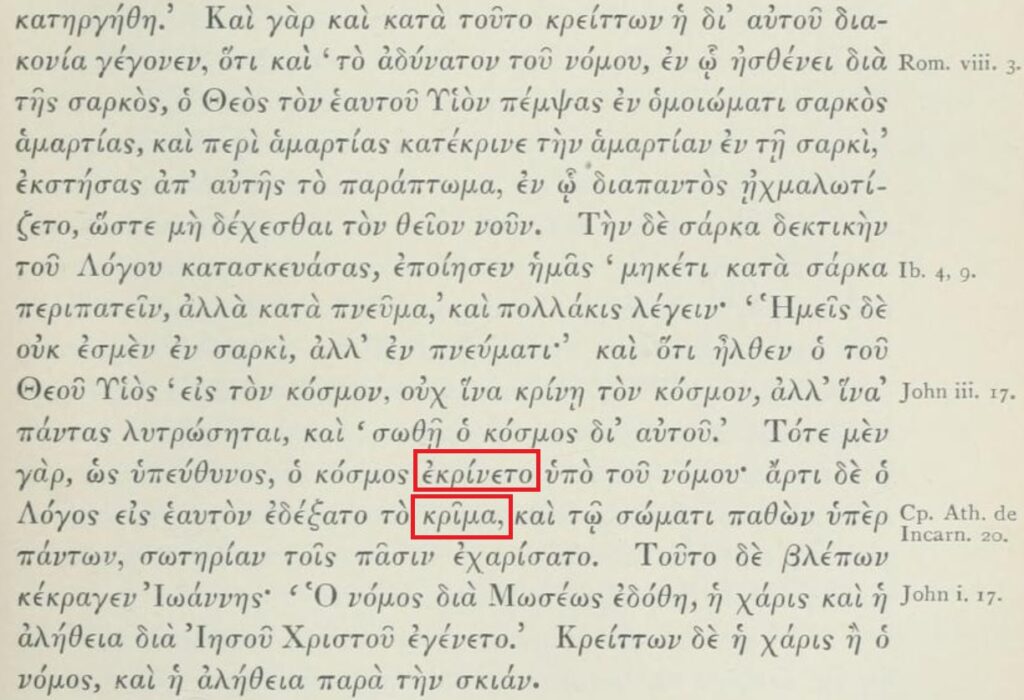
First, notice that we have the “huper” problem again. The phrase: “having suffered in the body for (huper) all” therefore means “having suffered in the body for the benefit of all“.
I’ve highlighted two words, the first of which has the translation: “was under judgment”, and the Greek word is “ἐκρίνετο” (ekrineto), and its base lexical form is “κρίνω” (krinó). Importantly, this is a Greek verb.
Usage: The Greek verb “krinó” primarily means to judge, decide, or determine. It encompasses a range of judicial and evaluative actions, from making a decision or forming an opinion to passing judgment in a legal or moral sense. In the New Testament, “krinó” is used in contexts that involve discernment, judgment, and condemnation, as well as in the sense of making a choice or decision.
There, it’s inflected as imperfect indicative middle verb, in the 3rd person singular. (And if you want to know what all of those mean, I recommend you check out my article: A Complete, 100% English Introduction to Koine Greek (with Examples in English) ). The most literal way of translating it — as I cover in the article I just linked to — is “was being judged“.
Formerly the world, as guilty, was being judged from the Law
Now, the word translated “from” just above is “ὑπό” (hupo), and it means:
Definition: by, under, beneath, through
Meaning: by, under, about.
So to be more literal, we now have:
Formerly the world, as guilty, was being judged by the Law
That should make perfect sense, and it aligns well with various passages of scripture as well. Now, we’ll look at the next clause:
but now the Word has taken on Himself the judgment
The word translated “judgment” is “κρίμα” (krima), the noun form of “κρίνω” (krinó) that we just looked at. Here’s what it means:
Usage: The term “krima” primarily refers to the act of judgment or the result of a judicial decision. It can denote a legal verdict, a sentence of condemnation, or the process of making a decision. In the New Testament, “krima” is often used in the context of divine judgment, highlighting God’s righteous and sovereign authority to judge human actions and intentions.
So while “krima” can refer to judgment in the sense of the penalty for a crime — and sometimes does — it more often refers to judgement in the sense of a judge rendering a verdict. This alone provides an obvious alternate meaning to the quote, but it gets worse.
The word translated “on” in the phrase “taken on Himself the judgment” is “εἰς” (eis), and here’s what it means in this context:
εἰς, a preposition governing the accusative, and denoting entrance into, or direction and limit: into, to, toward, for, among.
…
b. for one’s advantage or disadvantage; α. for, for the benefit of, to the advantage of:
And here’s an example of that use from the Bible:
Matthew 20:1 “For the kingdom of heaven is like a landowner who went out early in the morning to hire laborers for (eis) his vineyard.
I’ve personally translated most of the New Testament (80%+) from Greek to English, and can testify that “for” is a common usage for “eis”, especially in the epistles. (Shameless plug: you can read what I’ve translated so far here.)
Now, let’s put that all together:
Formerly the world, as guilty, was being judged by the Law; but now the Word has taken the judgment for Himself, and having suffered in the body for the benefit of all, has bestowed salvation to all.
This isn’t about Jesus suffering a penalty in our place as our substitute; it’s about Him having taken the judgement from the law and giving the ability to judge to Himself. The context of the quote proves this as well:
(Modified, with more context)
And having rendered the flesh capable of the Word, He made us walk, no longer according to the flesh, but according to the Spirit, and say again and again, ‘But we are not in the flesh but in the Spirit,’ and, ‘For the Son of God came into the world, not to judge the world, but to redeem all men, and that the world might be saved through Him John 3:17.’ Formerly the world, as guilty, was being judged by the Law; but now the Word has taken the judgment for Himself, and having suffered in the body for the benefit of all, has bestowed salvation to all. With a view to this has John exclaimed, ‘The law was given by Moses, but grace and truth came by Jesus Christ John 1:17.’ Better is grace than the Law, and truth than the shadow.
Athanasius quotes a verse about Jesus not coming to judge the world, mentions that the world was being judged by the law, then says Jesus took the ability to judge from the law and gave it to Himself. The result was salvation, which aligns with Jesus not coming to judge the world, but to save it.
However, even if I’m wrong about all of that…
Please don’t forget that we have a long treatise from Athanasius about why Christ died. Why would we take this single sentence out of context and use it to override the entire treatise that Athanasius wrote? How does that make sense?
Oi vey!
Lastly, remember that even if Athanasius meant that Jesus took our judgement on Himself as our substitute, that doesn’t mean it was penal substitution. Remember that Athanasius specifically said that God’s “judgment” for eating from the tree was physical death. According to Athanasius, Jesus tasted death in our place as our substitute so that we didn’t have to die, thus securing never-ending life for us on the New Heavens and New Earth.
Nowhere in the two works from Athanasius that we’ve seen does he say that Jesus was punished by God.
Another Athanasius quote
Here’s Mike Winger’s quote, copy/pasted directly from his notes, which again are available to all on his website.
And then, For, as when John says, ‘The Word was made flesh we do not conceive the whole Word Himself to be flesh, but to have put on flesh and become man, and on hearing, ‘Christ hath become a curse for us,’ and ‘He hath made Him sin for us who knew no sin,’ we do not simply conceive this, that whole Christ has become curse and sin, but that He has taken on Him the curse which lay against us (as the Apostle has said, ‘Has redeemed us from the curse,’ and ‘has carried,’ as Isaiah has said, ‘our sins,’ and as Peter has written, ‘has borne them in the body on the wood.’
That this quote is used to support PSA indicates a startling lack of reading comprehension, and also it ignores the immediate context of the work. We’ll get to the work’s context in a moment, but first we’ll get some more historical context. Gregory of Nazianzus said something similar, but more clearly. Both men wrote in the 300s — Gregory lived 329-390, Athanasius lived 298-373 — and both were extremely influential in the early church. Here’s Gregory of Nazianzus speaking more clearly on the same topic and verses.
Moreover, in no other way was it possible for the Love of God toward us to be manifested than by making mention of our flesh, and that for our sake He descended even to our lower part. For that flesh is less precious than soul, everyone who has a spark of sense will acknowledge. And so the passage, The Word was made Flesh, seems to me to be equivalent to that in which it is said that He was made sin, or a curse for us; not that the Lord was transformed into either of these, how could He be? But because by taking them upon Him He took away our sins and bore our iniquities. This, then, is sufficient to say at the present time for the sake of clearness and of being understood by the many.
Please read the Athanasius quote again with this understanding. The understanding that Gregory espouses makes perfect sense with the quote from Athanasius, but Gregory was just more clear. (And that was a common understanding at the time, as you’ll soon see in other quotes.)
Now, here’s the quote from Athanasius with more context around it.
For the Lord, knowing His own Essence to be the Only-begotten Wisdom and Offspring of the Father, and other than things originate and natural creatures, says in love to man, ‘The Lord created me a beginning of His ways,’ as if to say, ‘My Father has prepared for Me a body, and has created Me for men in behalf of their salvation.’ For, as when John says, ‘The Word was made flesh John 1:14,’ we do not conceive the whole Word Himself to be flesh , but to have put on flesh and become man, and on hearing, ‘Christ has become a curse for us,’ and ‘He has made Him sin for us who knew no sin ,’ we do not simply conceive this, that whole Christ has become curse and sin, but that He has taken on Him the curse which lay against us (as the Apostle has said, ‘Has redeemed us from the curse,’ and ‘has carried,’ as Isaiah has said, ‘our sins,’ and as Peter has written, ‘has borne them in the body on the wood ‘); so, if it is said in the Proverbs ‘He created,’ we must not conceive that the whole Word is in nature a creature, but that He put on the created body and that God created Him for our sakes, preparing for Him the created body, as it is written, for us, that in Him we might be capable of being renewed and deified.
Athanasius was NOT talking about Jesus’s death on the cross; he was talking about the incarnation.
Notice that the cross is barely mentioned except in a parenthetical statement. (And as we saw in a previous article, “borne” and “carried” in the passages mentioned mean “borne away” and “carried away”, not the typical PSA application.) This is important because it demonstrates something: when the early church fathers talked about Jesus “becoming a curse” or being made “into sin”, they were talking about His incarnation, not His death.
That’s important.
It’s anachronistic and misleading (intentionally or not) to say that a certain phrase means XYZ when it means ABC. Just because we phrase things one way in modern times doesn’t mean they were phrased that way in ancient times. A failure to recognize the difference can lead to incorrect conclusions about what the early church fathers taught.
That’s what happened here.
(And again, I don’t blame Mike Winger for this, he just trusted the wrong scholar.)
Being charitable, the scholar did it accidentally or simply had an extreme level of subconscious cognitive bias. Being realistic, I’m not sure how anyone who read the context could’ve missed this. I’m loath to suggest intentional twisting of truth in whoever assembled these quotes, but given the frequency with which the early church fathers are misrepresented, it’s possible. However, it’s also possible that there’s a case of eisegesis and/or extreme confirmation bias at work.
Athanasius, Letter to Maximus
The quote that Mike Winger uses is incredibly small, not even a whole sentence.
He also carried up our sins to the Tree.
This seems like reaching to me, particularly because Athanasius is quoting scripture. Here’s the full quote with plenty of context, though only the red part is relevant:
2. But if they are in doubt whether He is God at all, let them reverence Thomas, who handled the Crucified and pronounced Him Lord and God. John 20:28 Or let them fear the Lord Himself, who said, after washing the feet of the disciples: ‘You call Me Lord and Master , and you say well, for so I am.’ But in the same body in which He was when he washed their feet, He also carried up our sins to the Tree.1 Peter 2:24 And He was witnessed to as Master of Creation, in that the Sun withdrew his beams and the earth trembled and the rocks were rent, and the executioners recognised that the Crucified was truly Son of God. For the Body they beheld was not that of some man, but of God, being in which, even when being crucified, He raised the dead. Accordingly it is no good venture of theirs to say that the Word of God came into a certain holy man; for this was true of each of the prophets and of the other saints, and on that assumption He would clearly be born and die in the case of each one of them. But this is not so, far be the thought. But once for all ‘at the consummation of the ages Hebrews 9:26, to put away sin’ ‘the Word was made flesh John 1:14 ‘ and proceeded forth from Mary the Virgin, Man after our likeness, as also He said to the Jews, ‘Wherefore do you seek to kill Me, a man that has told you the truth ?’ And we are deified not by partaking of the body of some man, but by receiving the Body of the Word Himself.
Based solely on that quote above, you can’t establish that Athanasius believed PSA. You just can’t.
Further, we have a whole treatise from him on the topic of salvation and PSA never makes an appearance. To ignore an entire treatise in favor of a single quotation of scripture pulled out of context is silly. But, for completeness, let’s look at another place where Athanasius uses “carried up”:
For it was not the Word Himself that needed an opening of the gates, being Lord of all; nor were any of His works closed to their Maker; but we it was that needed it whom He carried up by His own body.
Source, end of chapter 25.
He “carried up” us as well…
Gregory of Nazianzus
Now, first I’ll show the quote that Mike Winger shared so you can see it, and then we’ll look at the quote within its larger context.
“As for my sake He was called a curse, Who destroyed my curse; and sin, who taketh away the sin of the world; and became a new Adam to take the place of the old, just so He makes my disobedience His own as head of the whole body. As long then as I am disobedient and rebellious, both by denial of God and by my passions, so long Christ also is called disobedient on my account.”
Remember above when we looked at Eusebius in Demonstratio Evangelica (Proof of the Gospel)? Remember how Eusebius said that because we are “in Christ”, He shares in everything we do? (“if one member suffer all the members suffer with it”) That sounds exactly like what Gregory of Nazianzus was saying with: “He makes my disobedience His own as head of the whole body“.
Like above, it’s also worth looking at what Gregory of Nazianzus says elsewhere:
Moreover, in no other way was it possible for the Love of God toward us to be manifested than by making mention of our flesh, and that for our sake He descended even to our lower part. For that flesh is less precious than soul, everyone who has a spark of sense will acknowledge. And so the passage, The Word was made Flesh, seems to me to be equivalent to that in which it is said that He was made sin, or a curse for us; not that the Lord was transformed into either of these, how could He be? But because by taking them upon Him He took away our sins and bore our iniquities. This, then, is sufficient to say at the present time for the sake of clearness and of being understood by the many.
That’s not PSA.
However, for completeness, we’ll look at Mike Winger’s quote more deeply, and with more context.
Notice how I highlighted the capital “A” in Mike Winger’s quote above? That’s because the quote makes it seem like it’s the start of a sentence when it’s not. Here’s the quote with more context, and the underlined part is what Mike Winger quotes:
Take, in the next place, the subjection by which you subject the Son to the Father. What, you say, is He not now subject, or must He, if He is God, be subject to God? You are fashioning your argument as if it concerned some robber, or some hostile deity. But look at it in this manner: that as for my sake He was called a curse, Who destroyed my curse; and sin, who takes away the sin of the world; and became a new Adam to take the place of the old, just so He makes my disobedience His own as Head of the whole body. As long then as I am disobedient and rebellious, both by denial of God and by my passions, so long Christ also is called disobedient on my account. But when all things shall be subdued unto Him on the one hand by acknowledgment of Him, and on the other by a reformation, then He Himself also will have fulfilled His submission, bringing me whom He has saved to God. For this, according to my view, is the subjection of Christ; namely, the fulfilling of the Father’s Will. But as the Son subjects all to the Father, so does the Father to the Son; the One by His Work, the Other by His good pleasure, as we have already said. And thus He Who subjects presents to God that which he has subjected, making our condition His own. Of the same kind, it appears to me, is the expression, “My God, My God, why hast Thou forsaken Me?” It was not He who was forsaken either by the Father, or by His own Godhead, as some have thought, as if It were afraid of the Passion, and therefore withdrew Itself from Him in His Sufferings (for who compelled Him either to be born on earth at all, or to be lifted up on the Cross?) But as I said, He was in His own Person representing us. For we were the forsaken and despised before, but now by the Sufferings of Him Who could not suffer, we were taken up and saved. Similarly, He makes His own our folly and our transgressions; and says what follows in the Psalm, for it is very evident that the Twenty-first Psalm refers to Christ.
Now, it is entirely laughable and patently absurd to say that Gregory of Nazianzus is talking about PSA if you’ve read his other works. It’s utterly laughable. In fact, any scholar who claims that is either woefully ignorant or being downright deceptive because Gregory of Nazianzus explicitly refutes the idea that Jesus’s blood was offered to God. (Though, that’s explicitly stated in Ephesians 5:2. Again, this article is about what the early church fathers taught, not if they were correct in their beliefs.)
Here’s the relevant quote:
Now we are to examine another fact and dogma, neglected by most people, but in my judgment well worth enquiring into. To Whom was that Blood offered that was shed for us, and why was It shed? I mean the precious and famous Blood of our God and High priest and Sacrifice. We were detained in bondage by the Evil One, sold under sin, and receiving pleasure in exchange for wickedness. Now, since a ransom belongs only to him who holds in bondage, I ask to whom was this offered, and for what cause? If to the Evil One, fie upon the outrage! If the robber receives ransom, not only from God, but a ransom which consists of God Himself, and has such an illustrious payment for his tyranny, a payment for whose sake it would have been right for him to have left us alone altogether. But if to the Father, I ask first, how? For it was not by Him that we were being oppressed; and next, On what principle did the Blood of His Only begotten Son delight the Father, Who would not receive even Isaac, when he was being offered by his Father, but changed the sacrifice, putting a ram in the place of the human victim? Is it not evident that the Father accepts Him, but neither asked for Him nor demanded Him; but on account of the Incarnation, and because Humanity must be sanctified by the Humanity of God, that He might deliver us Himself, and overcome the tyrant, and draw us to Himself by the mediation of His Son, Who also arranged this to the honour of the Father, Whom it is manifest that He obeys in all things?
Gregory of Nazianzus is espousing the “ransom theory” of how Jesus saves us, and we touched on it in the 11th article. (Ransom Theory says that man’s sin sold him into bondage to Satan, and Jesus’s death was a ransom payment to Satan to free mankind.)
Gregory of Nazianzus explicitly denies that Jesus’s death was a payment to God.
The PSA school says that Jesus’s death was a “payment” (of a sort) to God because PSA says that Jesus paid the penalty for our sins by dying in our place as our substitute. Gregory of Nazianzus clearly disagrees with this idea.
Now, some might say that the wording of “He was called a curse, Who destroyed my curse; and sin, who taketh away the sin of the world“. Might point toward PSA, but another quote from Gregory of Nazianzus should debunk that thoroughly. We’ve already seen it twice before, but it bears repeating in a shorter version.
And so the passage, The Word was made Flesh, seems to me to be equivalent to that in which it is said that He was made sin, or a curse for us; not that the Lord was transformed into either of these, how could He be? But because by taking them upon Him He took away our sins and bore our iniquities.
And again:
Why do I say, All things to all men? For even that which Paul could not endure to say of himself I find that the Saviour suffered. For He is made not only a Jew, and not only does He take to Himself all monstrous and vile names, but even that which is most monstrous of all, even very sin and very curse; not that He is such, but He is called so. For how can He be sin, Who sets us free from sin; and how can He be a curse, Who redeems us from the curse of the Law? But it is in order that He may carry His display of humility even to this extent, and form us to that humility which is the producer of exaltation.
Gregory of Nazianzus is most famous for the red portion of the following quote, which reveals much on the subject of his view of Christ’s work:
For that which He has not assumed He has not healed; but that which is united to His Godhead is also saved. If only half Adam fell, then that which Christ assumes and saves may be half also; but if the whole of his nature fell, it must be united to the whole nature of Him that was begotten, and so be saved as a whole.
Basically, Gregory of Nazianzus believed that Jesus had to unite every single aspect of man’s fallen nature with Himself. Once that was done, by virtue of Him also being God, He could heal everything He had taken on… which was everything. In modern times, this is sometimes called the “restored icon” model of how we are saved, and it dovetails perfectly with the cleansing model we saw in the 9th article.
That is categorically not PSA.
In fact, I have a suspicion — based admittedly on only a few of his works — that Gregory of Nazianzus would’ve called PSA a heresy and vehemently condemned it. So no, he didn’t teach PSA.
Ambrose of Milan
Here’s Mike Winger’s quote, and it comes from Ambrose’s homily: “Flight from the World”, which you can read here. It begins on page 281 of the book, which is page 290 of the PDF file. If you want to look at the original Latin, you can do so here. (Click the link “De Fuga Saeculi Liber Unus” to get the file.)
And so then, Jesus took flesh that He might destroy the curse of sinful flesh, and He became for us a curse that a blessing might overwhelm a curse, uprightness might overwhelm sin, forgiveness might overwhelm the sentence, and life might overwhelm death. He also took up death that the sentence might be fulfilled and satisfaction given for the judgment, the curse placed on sinful flesh even to death. Therefore, nothing was done contrary to God’s sentence when the terms of that sentence were fulfilled for the curse was unto death but grace is after death
Thankfully, and unusually for these quotes, the context doesn’t change this much.
Now, some historical context.
Ambrose of Milan lived from 339-397 AD (Anno Domini = Year of Our Lord). Notably, Athanasius wrote “On the Incarnation of the Word” not long before Ambrose of Milan was born. (4-21 years depending on which scholar you ask.) That means Ambrose of Milan was born and raised in a world where “On the Incarnation of the Word” would’ve been one of the most important church documents around. That goes double because it was literally the first treatise from a church father that was specifically focused on why Jesus incarnated and how He saved us.
That’s important.
Notably, Ambrose of Milan got the “of Milan” title because he was the bishop of Milan from 374 AD until the year of his death, 397 AD. “On the Incarnation of the Word” was written ~50 years (give or take) before he became a bishop, and certainly before he was born. If you think that a bishop of the church in the late 300s hadn’t read “On the Incarnation of the Word”, then I have some ocean-front property in Nevada that I think you would love… 😉
It would deny all logic, common sense, and reason to think that Ambrose hadn’t read “On the Incarnation of the Word”.
Now, given this perfectly reasonable assumption, it’s reasonable to ask if Ambrose’s view lines up with the view Athanasius explained in “On the Incarnation of the Word”. Long story short, it does, and perfectly so.
That leaves us with a question: is Ambrose referring to
- The view of Athanasius?
- Penal Substitutionary Atonement?
- Both?
I’m personally convinced of #1. However, #2 and #3 can’t be fully ruled out solely from the contents of “Flight from the World”, where the quote comes from. I personally think it doesn’t support PSA, but it definitely doesn’t argue against it either. Thus, I’ll mark this one as “could go either way”.
Moving on.
John Chrysostom
Neither of these quotes had citations either, so I had to go looking and it took a while to find them. Anyway, here’s the quote as Mike Winger presented it.
“Men ought to have been punished but God did not do so. They ought to have perished but He gave His son in their stead.”
“A king, seeing a robber about to receive his due, sends his beloved and only son to death and lays on him not only the penalty but also the crime, and this he does to save the guilty one and to promote him afterwards to high dignity.”
Again, those are from his notes, which are available on his website. We’ll look at these quotes one at a time.
Quote #1:
Here it is again.
“Men ought to have been punished but God did not do so. They ought to have perished but He gave His son in their stead.”
An observation first:
At the risk of being offensive, I must ask if basic reading comprehension skills were employed when deciding to use this quote to support PSA.
The verse literally says that we should have been punished, but God didn’t do that. That strikes at the very core of PSA. Further, this quote doesn’t say that Christ was punished instead of us. (This goes double because I’m writing this after reading some of his other works, but we’ll get there soon.)
Before we begin looking at this quote more deeply, I must point out that John Chrysostom lived from 347-407 AD. He was appointed Archbishop of Constantinople in 397 AD, so he had serious clout in the church. More importantly for this article, like Ambrose of Milan, John Chrysostom would definitely have been familiar with “On the Incarnation of the Word” by Athanasius. So we must ask if this quote fits with “On the Incarnation of the Word”, and it definitely does.
Thus, like Ambrose above, this quote is ambiguous at best because it fits Athanasius’ view just as well.
Now, I realize that PSA will object to this characterization and say that the second statement explains the first statement, and that the second one is clearly PSA.
Why must that be the case?
Again, think back to Athanasius and how his view involves substitution, but not penal substitution. John Chrysostom lived just after Athanasius, and their lives overlapped by several decades. It’s entirely reasonable to think that Chrysostom had Athanasius’s view, since Athanasius was a pillar of the church in his day.
However, unfortunately, there is no other context around this quote that sheds more light. (It’s his Homily #7 for those who want to read the full text, though that link’s translation of this particular phrase is inferior to what Mike Winger quoted. Yes I checked the original language, which you can read here if you’d like.)
We’ll pretend that Mike Winger’s version of the quote is inconclusive, and thus go to John Chrysostom’s other writings to get some clarity after a quick sidebar.
Sidebar: I would translate that quote differently. Feel free to ignore my translation because it would take too much space to walk through it. Please note, the two words I added in [brackets] are to communicate what I think the intended sense of the verse is, since Greek regularly likes to have the reader supply previously used words. I put the Greek directly below so those who know Greek can double-check me if they like.
He was about to punish them, [but] didn’t do this. They were about to perish, but instead of those men [perishing], He gave His own Son, and sent us as heralds to proclaim the cross.
Ἔµελλε τιµωρεῖσθαι αὐτούς τοῦτο οὐκ ἐποίησεν Ἀπόλλυσθαι ἔμελλον ἀλλ’ ἀντ’ ἐκείνων τὸν αὑτοῦ ἔδωκεν Υἱόν, καὶ κήρυκας ἡμᾶς ἔπεμψεν, ὥστε κηρύττειν τὸν σταυρόν
I think that’s a better and more literal translation. If I’m correct (which you don’t need to accept), properly translating it eliminates the support for PSA completely. As is often the case, the devil is in the details, which sometimes includes the translation details.
End sidebar.
Moving on to the next quote.
Quote #2
Here’s Mike Winger’s version.
A king, seeing a robber about to receive his due, sends his beloved and only son to death and lays on him not only the penalty but also the crime, and this he does to save the guilty one and to promote him afterwards to high dignity.”
Now, I don’t know where Mike Winger found that translation, but the ones I found online were considerably more neutral and complete than that one. In fact, the one that Mike Winger used (presumably from some “scholar”, using the term loosely), chops a fair number of words out.
Please compare the above with the quote below: (which includes more context)
If one that was himself a king, beholding a robber and malefactor under punishment, gave his well-beloved son, his only-begotten and true, to be slain; and transferred the death and the guilt as well, from him to his son, (who was himself of no such character,) that he might both save the condemned man and clear him from his evil reputation ; and then if, having subsequently promoted him to great dignity, he had yet, after thus saving him and advancing him to that glory unspeakable, been outraged by the person that had received such treatment: would not that man, if he had any sense, have chosen ten thousand deaths rather than appear guilty of so great ingratitude?
Well, that’s quite the difference, isn’t it?
Mike Winger’s version definitely sounds like PSA. The more complete quote leans that way, but isn’t nearly so stark. As always though, context is important, so we’ll back up to get some more context.
Context
All of these quotes come from John Chrysostom’s commentary on 2 Corinthians 5, which you can read here. Mike Winger’s quote is from his commentary on 5:21, which is a go-to verse to support PSA. (Even though on a closer inspection, its support for PSA is dubious at best because it’s directly contrary to lexicons; we saw this in the 14th article.)
Here’s part of his commentary on verse 19.
And how did He reconcile it unto Himself? For this is the marvel, not that it was made a friend only, but also by this way a friend. This way? What way? Forgiving them their sins; for in no other way was it possible. Wherefore also he added, Not reckoning unto them their tresspasses. For had it been His pleasure to require an account of the things we had transgressed in, we should all have perished; for all died. But nevertheless though our sins were so great, He not only did not require satisfaction, but even became reconciled; He not only forgave, but He did not even reckon. So ought we also to forgive our enemies, that ourselves too may obtain the like forgiveness.
Hmm, not sounding very much like PSA, is it? This following quote is at the end of the section on 2 Corinthians 5:20:
What can come up to this excess [of goodness]? He was outraged who had conferred innumerable benefits; having been outraged, He not only exacted not justice, but even gave His son that we might be reconciled. They that received Him were not reconciled, but even slew Him. Again, He sent other ambassadors to beseech, and though these are sent, it is Himself that entreats. And what does He entreat? Be reconciled unto God. And he said not, ‘Reconcile God to yourselves;’ for it is not He that bears enmity, but you; for God never bears enmity. Urging moreover his cause, like an ambassador on his mission, he says,
Please think about that in the context of PSA’s assertions about “the wrath of God against sin because of His justice“. Think on that for a moment while we gather yet more context, and this next quote is the next part of the work, literally the following line (which begins a new section.). It’s John Chrysostom’s commentary on 2 Corinthians 5:21.
2 Corinthians 5:21
For Him who knew no sin He made to be sin on our account.
‘I say nothing of what has gone before, that you have outraged Him, Him that had done you no wrong, Him that had done you good, that He exacted not justice, that He is first to beseech, though first outraged; let none of these things be set down at present. Ought ye not in justice to be reconciled for this one thing only that He has done to you now?’ And what has He done? Him that knew no sin He made to be sin, for you. For had He achieved nothing but done only this, think how great a thing it were to give His Son for those that had outraged Him. But now He has both well achieved mighty things, and besides, has suffered Him that did no wrong to be punished for those who had done wrong. But he did not say this: but mentioned that which is far greater than this.
If you think that John Chrysostom was teaching PSA after reading the context, then I’m afraid we’ll have to agree to disagree.
John Chrysostom clearly and explicitly repudiates PSA.
I’m not sure there’s an honest way to read this in context and think he taught PSA. Perhaps I’m wrong, but I don’t see it. If you include the context, a vastly different picture emerges than what Mike Winger presents. (Though again, I think Mike Winger is only guilty of trusting a dishonest scholar, because I don’t think he would intentionally mislead people.)
This gets even clearer if you read the context immediately around that quote.
Now, to the quote that Mike Winger used, here it is with more context, and the context changes things rather a lot.
If then we love Christ as it behooves to love Him, we shall punish ourselves when we sin. For to those who love any whomsover, not the suffering somewhat because they have provoked the beloved one is unpleasing; but above all, that they have provoked the person loved. And if this last when angered does not punish, he has tortured his lover more; but if he exacts satisfaction, he has comforted him rather. Let us therefore not fear hell, but offending God; for it is more grievous than that when He turns away in wrath: this is worse than all, this heavier than all. And that you may learn what a thing it is, consider this which I say. If one that was himself a king, beholding a robber and malefactor under punishment, gave his well-beloved son, his only-begotten and true, to be slain; and transferred the death and the guilt as well, from him to his son, (who was himself of no such character,) that he might both save the condemned man and clear him from his evil reputation ; and then if, having subsequently promoted him to great dignity, he had yet, after thus saving him and advancing him to that glory unspeakable, been outraged by the person that had received such treatment: would not that man, if he had any sense, have chosen ten thousand deaths rather than appear guilty of so great ingratitude? This then let us also now consider with ourselves, and groan bitterly for the provocations we have offered our Benefactor; nor let us therefore presume, because though outraged He bears it with long-suffering; but rather for this very reason be full of remorse.
Now, only looking at Mike Winger’s quote, I definitely see how someone could think that John Chrysostom taught PSA. However, with the context of everything around his quote, that isn’t really possible.
A closer look
Now, that said, let’s look at it a little closer, starting with the Greek word translated “guilt” in the phrase “and transferred the death and the guilt as well, from him to his son”. It’s the Greek word “αἰτία” (aitia), and it means:
αἰτία, (ας, ἡ;
1. cause, reason: Acts 10:21; Acts 22:24; Acts 28:20; κατά πᾶσαν αἰτίαν for every cause, Matthew 19:3; δἰ ἥν αἰτίαν for which cause, wherefore, Luke 8:47; 2 Timothy 1:6, 12; Titus 1:13; Hebrews 2:11; cf. Grimm on 2 Macc. 4:28.2. cause for which one is worthy of punishment; crime of which one is accused: Matthew 27:37; Mark 15:26; John 18:38; John 19:4 (6; Acts 23:28); αἰτία θανάτου (A. V. cause of death) crime deserving the punishment of death, Acts 13:28; Acts 28:18.
3. charge of crime, accusation: Acts 25:18, 27. (All these meanings are in secular writings also; (but Liddell and Scott now make meaning 3 the primary one).) In Matthew 19:10 the words εἰ οὕτως ἐστιν ἡ αἰτία τοῦ ἀνθρώπου μετά τήν γυναικός find a simple explanation in a Latinism (causa equivalent tores:si ita res se habet, etc.) if the case of the man with his wife is so.
Did you notice the word “guilt” anywhere in that definition?
Me either.
Let’s try Mounce’s lexicon then:
Gloss:
(legal) charge; reason, causeDefinition:
cause, motive, incitement; accusation, crime, case,
Hmm, not there either. I checked my paper copy of BDAG and didn’t see it there either. I might’ve missed it of course, but BDAG reads almost the same as Thayer’s lexicon.
(If you look at Strong’s — which is not a lexicon and shouldn’t be used like one — you’ll see that “guilt” does appear, but that’s simply because the NASB translates it that way in John 18:38, John 19:4, and John 19:6. All of those passages should be translated “cause for charges” or something similar. Its other uses indicate a cause/reason for something.)
Thus, let’s look at that quote again with a slightly better translation, and I’ve added the implied object of “cause” as well in brackets.
(Modified)
If one that was himself a king, beholding a robber and malefactor under punishment, gave his well-beloved son, his only-begotten and true, to be slain; and transferred the death and the cause [of death] as well, from him to his son, (who was himself of no such character,) that he might both save the condemned man and clear him from his evil reputation;
The cause of death is, of course, the corruption in our mortal bodies because of sin, as we covered in the 8th article on whether death was a punishment from God or a consequence of sin (or both). Jesus took on our sinful/corrupted flesh, though obviously without sinning, as it is written:
Romans 8:3
3 For what the Law could not do, weak as it was through the flesh, God did: sending His own Son in the likeness of sinful flesh and as an offering for sin, He condemned sin in the flesh,
So yeah, God Himself incarnated, taking on sinful flesh (the cause of death) and then died so that we could be resurrected in incorruptible bodies. That would align with what John Chrysostom taught within the context of this quote, and Athanasius as well.
However, PSA does not fit.
John Chrysostom certainly didn’t teach PSA, and we know this because he opens that section with statements that make PSA impossible.
Moving on.
Basil the Great
Here’s the quote Mike Winger used:
By the blood of Christ, through faith, we have been cleansed from all sin.
Basil, “On Baptism,” in ACCS NT XI, 96.
Now I don’t know about you, but to me, PSA seems entirely absent from that quote. There’s no mention of substitution, penalty, punishment, or anything else that’s central to PSA. It speaks only of cleansing, so reading PSA into that does violence to the plain text of what’s being said.
You can read the full text of the document here, but that exact phrasing never appears. It’s an accurate summary of Basil’s position, so I probably shouldn’t make too much of that, but I definitely thought that I should mention it.
We could look at the surrounding context, but thankfully, this quote so obviously doesn’t support PSA that we don’t need to.
Augustine of Hippo
Mike Winger presents three quotes:
(1) “But as Christ endured death as a man, and for man; so also, Son of God as He was, ever living in His own righteousness, but dying for our offences, He submitted as man, and for man, to bear the curse which accompanies death. And as He died in the flesh which He took in bearing our punishment, so also, while ever blessed in His own righteousness, He was cursed for our offenses, in the death which He suffered in bearing our punishment.”
(2) ‘For even the Lord was subject to death, but not on account of sin: He took upon Him our punishment, and so looseth our guilt.’
(3) ‘Now, as men were lying under this wrath by reason of their original sin… there was need for a mediator, that is for a reconciler, who by the offering of one sacrifice, of which all the sacrifices of the law and the prophets were types, should take away this wrath… Now when God is said to be angry, we do not attribute to Him such a disturbed feeling as exists in the mind of an angry man; but we call His just displeasure against sin by the name “anger” a word transferred by analogy from human emotions.’
We’ll look at them one at a time.
Augustine’s first quote
This quote comes from “Contra Faustum” (Against Faustus, a Manichean). Now, I don’t blame anyone for not reading this whole work. It’s a serious slog, and it’s not short. Augustine is called brilliant by many, but after reading so much of his work, I won’t be joining those ranks.
Anyway, before we look more closely at the work, there’s one quote that will become extremely important to understanding Mike Winger’s first quote, and here it is.
Now this is written in Genesis, Genesis 2:7 where it is related how God made man, and animated the body which He had formed of the earth. By the old man the apostle simply means the old life, which is a life in sin, and is after the manner of Adam, of whom it is said, “By one man sin entered into the world, and death by sin; and so death passed upon all men, in that all have sinned.” Romans 5:12 Thus the whole of this man, both the inner and the outer part, has become old because of sin, and liable to the punishment of mortality. There is, however, a restoration of the inner man, when it is renewed after the image of its Creator, in the putting off of unrighteousness — that is, the old man, and putting on righteousness — that is, the new man.
Source. (para 2)
That quote reveals something very important:
When Augustine says “punishment”, he means the “punishment of mortality”.
The punishment is to become mortal: to be able to die.
Now, we all have biases and lenses through which we see the world. A PSA fellow is likely to see “punishment” and assume that the punishment refers to penal substitution on the cross. However, that’s not what the early church thought. Augustine is hardly unique in this view, though we won’t look at other early church father quotes because Augustine is so clear about it in the following quotes.
Please keep the above quote in mind as you read the most relevant section of Against Faustus.
3. Death comes upon man as the punishment of sin, and so is itself called sin; not that a man sins in dying, but because sin is the cause of his death. So the word tongue, which properly means the fleshy substance between the teeth and the palate, is applied in a secondary sense to the result of the tongue’s action. In this sense we speak of a Latin tongue and a Greek tongue. The word hand, too, means both the members of the body we use in working, and the writing which is done with the hand. In this sense we speak of writing as being proved to be the hand of a certain person, or of recognizing the hand of a friend. The writing is certainly not a member of the body, but the name hand is given to it because it is the hand that does it. So sin means both a bad action deserving punishment, and death the consequence of sin. Christ has no sin in the sense of deserving death, but He bore for our sakes sin in the sense of death as brought on human nature by sin. This is what hung on the tree; this is what was cursed by Moses. Thus was death condemned that its reign might cease, and cursed that it might be destroyed. By Christ’s taking our sin in this sense, its condemnation is our deliverance, while to remain in subjection to sin is to be condemned.
4. What does Faustus find strange in the curse pronounced on sin, on death, and on human mortality, which Christ had on account of man’s sin, though He Himself was sinless? Christ’s body was derived from Adam, for His mother the Virgin Mary was a child of Adam. But God said in Paradise, “On the day that you eat, you shall surely die.” This is the curse which hung on the tree. A man may deny that Christ was cursed who denies that He died. But the man who believes that Christ died, and acknowledges that death is the fruit of sin, and is itself called sin, will understand who it is that is cursed by Moses, when he hears the apostle saying “For our old man is crucified with Him.” Romans 6:6 The apostle boldly says of Christ, “He was made a curse for us;” for he could also venture to say, “He died for all.” “He died,” and “He was cursed,” are the same. Death is the effect of the curse; and all sin is cursed, whether it means the action which merits punishment, or the punishment which follows. Christ, though guiltless, took our punishment, that He might cancel our guilt, and do away with our punishment.
Again, let me remind you — if it wasn’t clear enough from these two paragraphs — that by “punishment” here, Augustine is referring to mortality. Anyway, continuing with the very next paragraph/sentence:
5. These things are not my conjectures, but are affirmed constantly by the apostle, with an emphasis sufficient to rouse the careless and to silence the gainsayers. “God,” he says, “sent His Son in the likeness of sinful flesh, that by sin He might condemn sin in the flesh.” Romans 8:3 Christ’s flesh was not sinful, because it was not born of Mary by ordinary generation; but because death is the effect of sin, this flesh, in being mortal, had the likeness of sinful flesh. This is called sin in the following words, “that by sin He might condemn sin in the flesh.” Again he says: “He has made Him to be sin for us who knew no sin, that we might be made the righteousness of God in Him.” 2 Corinthians 5:21 Why should not Moses call accursed what Paul calls sin? In this prediction the prophet claims a share with the apostle in the reproach of the heretics. For whoever finds fault with the word cursed in the prophet, must find fault with the word sin in the apostle; for curse and sin go together.
6. If we read, “Cursed of God is every one that hangs on a tree,” the addition of the words “of God” creates no difficulty. For had not God hated sin and our death, He would not have sent His Son to bear and to abolish it. And there is nothing strange in God’s cursing what He hates. For His readiness to give us the immortality which will be had at the coming of Christ, is in proportion to the compassion with which He hated our death when it hung on the cross at the death of Christ.
And a little further on in that same book (book 14):
Be assured, Cursed is every one that hangs on a tree is no old wife’s railing, but a prophetical utterance. Christ, by the curse, takes the curse away, as He takes away death by death, and sin by sin. In the words, “Cursed is every one that hangs on a tree,” there is no more blasphemy than in the words of the apostle, “He died,” or, “Our old man was crucified along with Him,” Romans 6:6 or, “By sin He condemned sin,” Romans 8:3 or, “He made Him to be sin for us who knew no sin,” 2 Corinthians 5:21 and in many similar passages. Confess, then, that when you exclaim against the curse of Christ, you exclaim against His death. If this is not an old wife’s railing on your part, it is devilish delusion, which makes you deny the death of Christ because your own souls are dead. You teach people that Christ’s death was feigned, making Christ your leader in the falsehood with which you use the name of Christian to mislead men.
Now, with all that context, here’s Mike Winger’s quote again:
“But as Christ endured death as a man, and for man; so also, Son of God as He was, ever living in His own righteousness, but dying for our offences, He submitted as man, and for man, to bear the curse which accompanies death. And as He died in the flesh which He took in bearing our punishment, so also, while ever blessed in His own righteousness, He was cursed for our offenses, in the death which He suffered in bearing our punishment.”
Suddenly, it’s not so clearly PSA.
When you understand that Augustine meant “mortality” when he says “punishment”, and that he considered death, sin, and curse synonymous, the support for PSA in this quote simply melts away. I suppose you could argue that it’s not completely gone, but it is greatly weakened at the very least.
Now, after having read the whole thing, I don’t think that Augustine was a PSA fellow. Part of the reason for that is the following quote:
You attempt to prove, by a comparison of Christ and Moses, that they are unlike, and that therefore the words, “I will raise up a prophet like you,” cannot be understood of Christ. You specify a number of particulars in which you find a diversity: that the one is man, and the other God; that one is a sinner, the other sinless; that one is born of ordinary generation, the other, as we hold, of a virgin, and, as you hold, not even of a virgin; the one incurs God’s anger, and is put to death on a mountain, the other suffers voluntarily, having throughout the approval of His Father. But surely things may be said to be like, although they are not like in every respect.
That’s a little awkward for PSA…
No matter which specific flavor of PSA you hold to, that causes major problems. PSA says that God poured out His wrath against sin on Jesus on the cross, and that doesn’t really work well with “having throughout the approval of His Father“. Okay, I’ll concede that it’s not an impossible stretch that PSA could make, but it really is a Reed Richards (or Elastagirl from “The Incredibles”) level stretch. Possible, but very unlikely.
Augustine’s second quote
Here it is again as Mike Winger presents it:
‘For even the Lord was subject to death, but not on account of sin: He took upon Him our punishment, and so looseth our guilt.’
I could answer this with one sentence that we’ve already looked at:
Thus the whole of this man, both the inner and the outer part, has become old because of sin, and liable to the punishment of mortality.
That could explain this quote perfectly right here, no need to go further. Again, this would be talking about Jesus taking on mortality by becoming human. However, we will go further and look at more of the work this comes from.
Apart from this bond of mortal concupiscence was Christ born without a male, of a virgin conceiving by the Holy Ghost. He cannot be said to have been conceived in iniquity, it cannot be said, In sins His mother nourished Him in the womb, to whom was said, “The Holy Ghost shall come upon you, and the Virtue of the Highest shall overshadow you.” Luke 1:35 It is not therefore because it is sin to have to do with wives that men are conceived in iniquity, and in sins nourished in the womb by their mother; but because that which is made is surely made of flesh deserving punishment. For the punishment of the flesh is death, and surely there is in it liability to death itself. Whence the Apostle spoke not of the body as if to die, but as if dead: “The body indeed is dead,” he says, “because of sin, but the Spirit is life because of righteousness.” Romans 8:10 How then without bond of sin is born that which is conceived and sown of a body dead because of sin? This chaste operation in a married person has not sin, but the origin of sin draws with it condign punishment. For there is no husband that, because he is an husband, is not subject to death, or that is subject to death for any other reason but because of sin. For even the Lord was subject to death, but not on account of sin: He took upon Him our punishment, and so looses our guilt. With reason then, “In Adam all die, but in Christ shall all be made alive.” 1 Corinthians 15:22 For, “Through one man,” says the Apostle, “sin has entered into this world, and through sin death, and so has passed unto all men, in that all have sinned.” Romans 5:12 Definite is the sentence: “In Adam,” he says, “all have sinned.” Alone then could such an infant be innocent, as has not been born of the work of Adam.
(Note: there are a few other passages from this work that sound like PSA, but only if you don’t read them carefully. I decided not to include them for length, and because the PSA school doesn’t use them.)
Even ignoring Augustine’s “punishment = mortality” view, there’s another important thing to consider: I feel like a broken record, but does this fit with the view Athanasius espoused?
Yes?
Does it clearly include any elements of PSA besides substitution?
No?
Then why would we assume that it must be PSA, when it could also perfectly fit the dominant view of the day? (Athanasius’s view)
Quite beside the fact that Augustine viewed mortality as the punishment of sin, and thus Jesus took on “our punishment” when He became mortal, it makes far more historical sense to think that Augustine believed the dominant view of his day.
Augustine’s third quote:
Mike Winger’s version of the quote:
“Now, as men were lying under this wrath by reason of their original sin… there was need for a mediator, that is for a reconciler, who by the offering of one sacrifice, of which all the sacrifices of the law and the prophets were types, should take away this wrath… Now when God is said to be angry, we do not attribute to Him such a disturbed feeling as exists in the mind of an angry man; but we call His just displeasure against sin by the name “anger” a word transferred by analogy from human emotions.”
Again — and I apologize in advance to Mr. Winger if he ever reads this article — but were basic reading comprehension skills employed when deciding to use this quote to support PSA?
For those who don’t know, “original sin” is the idea that at the moment of conception, the new person created is guilty of sin and under God’s wrath, and deserves eternal torment just because of the “fallen state” in which he or she was conceived. Notice the phrase “should take away this wrath”, especially the word “this”. Augustine is only referring to God’s wrath against original sin.
Mike Winger doesn’t hold to Original Sin.
(Check his video: “Infant Salvation Causes These Theological Riddles (CONJECTURE WARNING): The Mark Series pt 36” to see him disagree with it.) It makes absolutely no sense whatsoever to deny Original Sin and then use this quote to support PSA.
Now, Augustine actually thought that original sin was worse than personal sin in its severity.
This is obvious from the full quote, rather than the clipped one that Mike Winger shared (again, he didn’t do the clipping, so I don’t blame him for this.)
And so the human race was lying under a just condemnation, and all men were the children of wrath. Of which wrath it is written: All our days are passed away in Your wrath; we spend our years as a tale that is told. Of which wrath also Job says: Man that is born of a woman is of few days, and full of trouble. Of which wrath also the Lord Jesus says: He that believes in the Son has everlasting life: and he that believes not the Son shall not see life; but the wrath of God abides on him. He does not say it will come, but it abides on him. For every man is born with it; wherefore the apostle says: We were by nature the children of wrath, even as others. Now, as men were lying under this wrath by reason of their original sin, and as this original sin was the more heavy and deadly in proportion to the number and magnitude of the actual sins which were added to it, there was need for a Mediator, that is, for a reconciler, who, by the offering of one sacrifice, of which all the sacrifices of the law and the prophets were types, should take away this wrath. Wherefore the apostle says: For if, when we were enemies, we were reconciled to God by the death of His Son, much more, being reconciled, we shall be saved by His life. Now when God is said to be angry, we do not attribute to Him such a disturbed feeling as exists in the mind of an angry man; but we call His just displeasure against sin by the name anger, a word transferred by analogy from human emotions. But our being reconciled to God through a Mediator, and receiving the Holy Spirit, so that we who were enemies are made sons (For as many as are led by the Spirit of God, they are the sons of God ): this is the grace of God through Jesus Christ our Lord.
The whole section is on Original Sin, not personal sin.
Even if it was about personal sin, there’s a section heading to disambiguate the issue for us:
Chapter 49. Christ Was Not Regenerated in the Baptism of John, But Submitted to It to Give Us an Example of Humility, Just as He Submitted to Death, Not as the Punishment of Sin, But to Take Away the Sin of the World.
And, if you really want to know what Augustine thought, this section of “On the Trinity”, book 13 should clear it up.
Chapter 11.— A Difficulty, How We are Justitified in the Blood of the Son of God.
15. But what is meant by justified in His blood? What power is there in this blood, I beseech you, that they who believe should be justified in it? And what is meant by being reconciled by the death of His Son? Was it indeed so, that when God the Father was angry with us, He saw the death of His Son for us, and was appeased towards us? Was then His Son already so far appeased towards us, that He even deigned to die for us; while the Father was still so far angry, that except His Son died for us, He would not be appeased? And what, then, is that which the same teacher of the Gentiles himself says in another place: What shall we then say to these things? If God be for us, who can be against us? He that spared not His own Son, but delivered Him up for us all; how has He not with Him also freely given us all things? Pray, unless the Father had been already appeased, would He have delivered up His own Son, not sparing Him for us? Does not this opinion seem to be as it were contrary to that? In the one, the Son dies for us, and the Father is reconciled to us by His death; in the other, as though the Father first loved us, He Himself on our account does not spare the Son, He Himself for us delivers Him up to death. But I see that the Father loved us also before, not only before the Son died for us, but before He created the world; the apostle himself being witness, who says, According as He has chosen us in Him before the foundation of the world. Nor was the Son delivered up for us as it were unwillingly, the Father Himself not sparing Him; for it is said also concerning Him, Who loved me, and delivered up Himself for me. Therefore together both the Father and the Son, and the Spirit of both, work all things equally and harmoniously; yet we are justified in the blood of Christ, and we are reconciled to God by the death of His Son. And I will explain, as I shall be able, here also, how this was done, as much as may seem sufficient.
I’m not sure how you could think that Augustine believed PSA after reading that quote.
Cyril of Alexandria
This is the quote directly copy/pasted from Mike Winger’s notes: (Emphasis original)
- “The Only-begotten was made man, bore a body by nature at enmity with death, and became flesh, so that, enduring the death which was hanging over us as the result of our sin, he might abolish sin; and further, that he might put an end to the accusations of Satan, inasmuch as we have paid in Christ himself the penalties for the charges of sin against us: ‘For he bore our sins, and was wounded because of us’, according to the voice of the prophet. Or are we not healed by his wounds?”
- “this chastisement, which was due to fall on sinners… descended on him.”
- Commentary on Isaiah 53.
Now, sadly it seems like there isn’t an English translation of the full document available online anywhere. I’m sure you’ve seen how much context can change things, even in quotes that seem decisive. Thus, there’s no real way to engage with this particular quote.
Further, this quote fits just as well with Athanasius’s view as it does with PSA.
Like PSA, Athanasius said that Jesus endured death as a substitute for us, and that he “paid the penalty of sin” (which is death in Athanasius’s view) for us to free us. However, unlike PSA, Athanasius didn’t believe that God’s wrath or justice were the cause. Thus, Jesus paid “the penalties for the charges of sin against us” by dying, so that in him, we might taste death. Given that Cyril came not long after Athanasius, it’s entirely reasonable to think that Cyril had Athanasius’ understanding in mind.
I’ll file this under “unclear” for those reasons. (Can’t read the context and it fits with Athanasius just as well.)
Okay, it’s time for the next one…
…but there isn’t a next one.
That’s the last one.
Early church father quotes wrap-up
Long story short, none of them clearly teach PSA. Not a single one. A couple might be indeterminate, but all of those can work perfectly with the understanding that Athanasius espoused in “On the incarnation of the Word”. Given that:
- Athanasius was a pillar of the church in his day,
- “On the incarnation of the Word” was literally the first treatise on why Jesus came,
- It aligns quite well with what the other early church fathers taught
Why would we think that the other church fathers espoused PSA when Athanasius’s view fits just as well? Further, many of the early church fathers made statements that explicitly repudiated PSA, so why would we think they believed it? That doesn’t make any sense.
How PSA came to be
Once I realized that the early church didn’t seem to be espousing PSA, I went looking for the history. This article is already absurdly long, so I won’t do a full history, merely a gloss of moderate depth.
Basically, there were two major steps (with all kinds of smaller ones in between).
The first step was from the Catholic Archbishop Anselm of Canterbury in his book “Cur Deus Homo”, published at the very end of the 11th century. Notably, this is about 40 years after the Catholic church officially came into existence after the East/West split of 1054. The split was messy, and the religious elements of the dispute boil down to: (1) a dispute about the nature of the Trinity (search “Filioque” for more information), and (2) if the bishop of Rome had any more authority than any other bishop.
(Basically, the bishop of Rome held the title of “first among equals”, meaning more honor, but he didn’t have any more authority. Rome didn’t like that, and wanted papal authority to enforce their position on the Trinitarian debate. The Eastern Orthodox said “no”, rejecting the idea that the bishop of Rome had more authority by maintaining that all the bishops had equal say, and maintaining their understanding of the Trinity. And yes, that’s a gross oversimplification, but this article is already long and the history of the split isn’t very relevant to our topic, interesting though it is.)
Anselm was the first person who I could find that said that we needed to be saved from divine justice.
If there are prior examples, I missed them in my research. That said, I did a lot of research and virtually all non-PSA fellows agree. In fact, some PSA fellows agree. Dr. James White, a popular Calvinist apologist, has been quoted as saying that PSA “is a reformed doctrine”, meaning from the time of, and springing from the Protestant Reformation in the 16th century.
I agree with him on that.
Not much else, but at least that.
However, the roots and basic groundwork were laid by Anselm; he laid the foundation on which PSA was built.
The following is my summation of Anselm’s position in “Cur Deus Homo”, with quotes to follow if you want to read excerpts in his own words.
As you read this, remember that it was written in a medieval context, by someone immersed in the feudal system.
That’ll help it make sense.
Basically, man’s sin offends God’s honor, and in so doing stole honor from God, and God’s justice wouldn’t let His honor remain uncompensated. If we didn’t “give satisfaction” — meaning to repay the value of the lost honor — we would be liable to punishment. However, being mere men, we had nothing of value with which to repay God for His lost honor. Thus, Jesus became man so that a God-man could repay God. Jesus’s blood/death was so precious — being of infinite worth — as to repay God for all the finite sins of mankind throughout all ages. Thus, with God’s honor repaid, God wasn’t required by His justice to punish us.
I’m sure you see how close that is to PSA, but it’s obviously not the same. This is called the “Satisfaction” view, after the medieval idea of giving satisfaction for lost honor. This is currently the view of the Catholic Church, though they’ve tweaked it slightly since Anselm.
Now, for those who want that in Anselm’s words, here it is. These are distilled from the work, which is rather long and tedious since he spends so much time on irrelevant points. However, I think they accurately represent his position.
Book 1
Chapter XI: “To sin is nothing else than not to render to God his due … Every wish of a rational creature should be subject to the will of God. This is the debt which man and angel owe to God … He who does not render this honor which is due to God, robs God of his own and dishonors him; and this is sin. Moreover, so long as he does not restore what he has taken away, he remains in fault; and it will not suffice merely to restore what has been taken away, but, considering the contempt offered, he ought to restore more than he took away … every one who sins ought to pay back the honor of which he has robbed God; and this is the satisfaction which every sinner owes to God.”
Chapter XII: “To remit sin in this manner is nothing else than not to punish; and since it is not right to cancel sin without compensation or punishment; if it be not punished, then is it passed by undischarged. It is not fitting for God to pass over anything in his kingdom undischarged … there will be no difference between the guilty and the not guilty; and this is unbecoming to God.”
Chapter XIII: “In the order of things, there is nothing less to be endured than that the creature should take away the honor due the Creator, and not restore what he has taken away … God maintains nothing with more justice than the honor of his own dignity. Does it seem to you that he wholly preserves it, if he allows himself to be so defrauded of it as that he should neither receive satisfaction nor punish the one defrauding him? Therefore the honor taken away must be repaid, or punishment must follow.”
And from the second part of the work:
Book 2
Chapter VI: “But this cannot be effected, except the price paid to God for the sin of man be something greater than all the universe besides God … Therefore none but God can make this satisfaction. … But none but a man ought to do this, other wise man does not make the satisfaction. … If it be necessary, therefore, as it appears, that the heavenly kingdom be made up of men, and this cannot be effected unless the aforesaid satisfaction be made, which none but God can make and none but man ought to make, it is necessary for the God-man to make it.”
Chapter VII: “Therefore the God-man, whom we require to be of a nature both human and Divine … For God will not do it, because he has no debt to pay; and man will not do it, because he cannot. Therefore, in order that the God‑man may perform this, it is necessary that the same being should perfect God and perfect man, in order to make this atonement. For he cannot and ought not to do it, unless he be very God and very man.”
(Note: this is actually where the practice of indulgences comes from, where you could pay the church money so a loved one could spend less time in purgatory. Again, this was tied to the idea of repaying God for lost honor; quite literally in the indulgence system.)
It’s worth noting that Anselm rarely uses scripture to establish his Satisfaction Theory. There are a few allusions, but he doesn’t draw this doctrine from scripture and preferred to rely on reason instead.
Now, during the Protestant Reformation, things shifted.
The idea of lost honor was entirely medieval and belonged to the feudal system, and the world was slowly moving past that. Thus, there was a shift from Jesus repaying God because His blood was of infinite worth so God wouldn’t have to punish us, to God punishing Jesus so he didn’t have to punish us, because Jesus had already been punished to repay God for His lost Honor.
This following quote is from Martin Luther. Note how similar the language is to Anselm, only with a focus on punishment as a method of dealing with lost honor, rather than repayment. The satisfaction/repayment language remains though.
But now, if God’s wrath is to be taken away from me and I am to obtain grace and forgiveness, some one must merit this; for God cannot be a friend of sin nor gracious to it, nor can he remit the punishment and wrath, unless payment and satisfaction be made. Now, no one, not even an angel of heaven, could make restitution for the infinite and irreparable injury and appease the eternal wrath of God which we had merited by our sins; except that eternal person, the Son of God himself, and he could do it only by taking our place, assuming our sins, and answering for them as though he himself were guilty of them. This our dear Lord and only Savior and Mediator before God, Jesus Christ, did for us by his blood and death, in which he became a sacrifice for us; and with his purity, innocence, and righteousness, which was divine and eternal, he outweighed all sin and wrath he was compelled to bear on our account; yea, he entirely engulfed and swallowed it up, and his merit is so great that God is now satisfied and says, If he wills thereby to save, then there shall be a salvation.
John Calvin slid more toward punishment and away from repayment, and it didn’t take long for the slide to be completed and the idea of “repaying God for His lost honor” to completely disappear. Thus, PSA became a fully fledged system after separating from Anselm’s Satisfaction Theory. Though, the two systems still are quite similar, and remain the only two that see God’s justice as a problem that needs to be solved.
There’s a lot more history, but that’ll suffice for this series. Other, far more qualified people have done the legwork to trace the history of PSA, so I’ll leave such things to them.
For now, let’s bring this article in for a landing.
Conclusion
Let’s start with a Mike Winger quote from his video on the topic:
One side is not playing fair in the modern debate on the topic of how Jesus saves us. They’re not playing fair at all. In fact they’re very underhanded. I’m just being honest here. I’m not mad about it, although sometimes I’m a little mad about it in that moment, not at this moment. Sometimes they’re underhanded; they use deceitful tactics and they just use false information like historical revisionism
Sadly, I can agree with that, though Mike and I would disagree about which side is engaging in historical revisionism. Again, I don’t blame Mike Winger because I don’t think he’d ever be intentionally deceptive. He simply trusted that whoever assembled these quotes was being honest; sadly, they weren’t. That’s not Mike’s fault, and he would likely be upset at that if he knew.
The simple fact is that PSA has been using deceptively edited quotes, and/or quotes without context to support the idea that the early church taught PSA. When read in context, none of the quotes clearly support PSA. Many seem to support substitution, but not penal substitution. Athanasius is especially illuminating because his view — which likely was the dominant one given his influence — includes substitution, but isn’t penal substitution.
Some of the early church fathers actually repudiate core elements of PSA.
Not all of them, and not even most, but several of them do. That’s a hard blow to the idea that PSA was taught by the early church fathers.
In fact, here’s Mike Winger from his video on the Church Fathers:
if they say something weird it doesn’t mean we should believe it, and they do say lots of weird things by the way, but if in all of their writings you can’t even find a central– what you think is central to the gospel, and you can’t find it in any of the writings over hundreds of years, well then you’ve probably made it up. Like that, you know, that’s like a good red flag to go back to your Bible and reevaluate your understanding. So let’s, let’s take this to task and take it as a serious objection to penal substitutionary atonement
Again, I agree with Mike, but he might not like how I’ll apply it after doing all the research…
Now, again, I obviously didn’t read everything that the early church fathers wrote, nor even every work by the writers quoted in this article. It’s possible that there’s an explicit statement endorsing PSA in one of the early church fathers, and I just missed it. However, again, I think that PSA believers would put forth the best quotes they could find to support PSA, so I think it’s reasonable to assume that these are the best quotes that they’ve found. I could be wrong, but that seems like a fair assumption.
Thus, based solely on the quotes that PSA believers put forth (which are likely, but not certainly, the strongest ones), PSA appears to be entirely absent from the early church.
Entirely.
Thus, as Mike suggested, it seems like a good idea to go back to your Bible and reevaluate your understanding of how Jesus saves, and what He saves us from. We’ve been doing that in this series, starting from the intro article.
Now, we’re coming to the end of this long journey investigating PSA.
Unless something drastic and unforeseen happens, there will only be one more article in this series, and that article will be a wrap-up and summary of the series and its overall conclusions. I’ll add a link to that article when it’s finished, and I’ll see you there.
God Bless,
Berean Patriot

)
Hi Berean Patriot,
You said that according to Clement, God is “free from wrath” toward all his creation, including “man and beast and all the living beings upon it“ but you disagree about wrath since Romans 1:18 says:
“For the wrath of God is revealed from heaven against all ungodliness and unrighteousness of men who suppress the truth in unrighteousness”
Romans 1:18 is actually saying God’s wrath is against “ungodliness” (not the ungodly), and “unrighteousness” (not the unrighteous) – in other words its not his creation that he’s wrathful towards; its the activities of men (not the men themselves).
That’s a solid point about that verse, the direct object is indeed the ungodliness and unrighteousness. Though, if you go forward one chapter, we do see wrath directed against the men themselves; note especially v5 and v8.
Good point, and I should edit which verse I cite when I get some time.
Thanks for this very helpful series, BP! Do you plan to do any article(s) on the correct understanding of justice? For instance, the way most of us are trained to understand it, we think that sin/wrongdoing MUST be judged. You have established well that this is not the case, but if that is not what justice is, what is it? What does it mean that God is just? I’ve been looking into the arguments put forward by Eitan Bar on this topic, but I was curious what your thoughts were.
You’re welcome. 🙂
Honestly, I don’t think there’s very much wrong with how justice is normally understood, outside of PSA. For example, few reasonable people have a problem with the guilty always being punished, but then also allowing for a pardon/clemency for those who are truly repentant. I think that God is just in the sense that He always ascribes fault/guilt where it should be, and yet is merciful enough to forgive/pardon the repentant. That’s off the top of my head though, and my view might change if I looked deeper into it.