 Welcome to the 15th article in this series investigating PSA to see if it’s true. In the previous article, we examined 2 Corinthians 5:21 to see if Jesus was made “into sin”, and this time we’ll look at a passage that many in the PSA camp consider to be parallel, or at least similar.
Galatians 3:13
13 Christ redeemed us from the curse of the Law, having become a curse for us—for it is written, “CURSED IS EVERYONE WHO HANGS ON A TREE”—
Importantly, this is a reference to the Old Testament, which you can easily tell because the NASB 95 puts Old Testament quotations in all CAPS. This is the verse that Galatians 3:13 references:
Deuteronomy 21:22-23
22 “If a man has committed a sin worthy of death and he is put to death, and you hang him on a tree, 23 his corpse shall not hang all night on the tree, but you shall surely bury him on the same day (for he who is hanged is accursed of God), so that you do not defile your land which the LORD your God gives you as an inheritance.
The important part of this allusion is that the curse comes from God Himself. Thus, the PSA school of thought says that this verse establishes that Jesus was cursed by God vicariously in our place as our substitute, virtually proving that PSA is true.
We’ll examine that claim today.
Looking at the verse through the lens of PSA
For the sake of argument, we’ll assume that PSA is true in this section. Then, through that lens, we’ll see if Galatians 3:13 supports it. The whole passage is below for the full context.
Galatians 3:1-18
1 You foolish Galatians, who has bewitched you, before whose eyes Jesus Christ was publicly portrayed as crucified? 2 This is the only thing I want to find out from you: did you receive the Spirit by the works of the Law, or by hearing with faith? 3 Are you so foolish? Having begun by the Spirit, are you now being perfected by the flesh? 4 Did you suffer so many things in vain—if indeed it was in vain? 5 So then, does He who provides you with the Spirit and works miracles among you, do it by the works of the Law, or by hearing with faith?
6 Even so Abraham BELIEVED GOD, AND IT WAS RECKONED TO HIM AS RIGHTEOUSNESS. 7 Therefore, be sure that it is those who are of faith who are sons of Abraham. 8 The Scripture, foreseeing that God would justify the Gentiles by faith, preached the gospel beforehand to Abraham, saying, “ALL THE NATIONS WILL BE BLESSED IN YOU.” 9 So then those who are of faith are blessed with Abraham, the believer.
10 For as many as are of the works of the Law are under a curse; for it is written, “CURSED IS EVERYONE WHO DOES NOT ABIDE BY ALL THINGS WRITTEN IN THE BOOK OF THE LAW, TO PERFORM THEM.” 11 Now that no one is justified by the Law before God is evident; for, “THE RIGHTEOUS MAN SHALL LIVE BY FAITH.” 12 However, the Law is not of faith; on the contrary, “HE WHO PRACTICES THEM SHALL LIVE BY THEM.” 13 Christ redeemed us from the curse of the Law, having become a curse for us—for it is written, “CURSED IS EVERYONE WHO HANGS ON A TREE”— 14 in order that in Christ Jesus the blessing of Abraham might come to the Gentiles, so that we would receive the promise of the Spirit through faith.
15 Brethren, I speak in terms of human relations: even though it is only a man’s covenant, yet when it has been ratified, no one sets it aside or adds conditions to it. 16 Now the promises were spoken to Abraham and to his seed. He does not say, “And to seeds,” as referring to many, but rather to one, “And to your seed,” that is, Christ. 17 What I am saying is this: the Law, which came four hundred and thirty years later, does not invalidate a covenant previously ratified by God, so as to nullify the promise. 18 For if the inheritance is based on law, it is no longer based on a promise; but God has granted it to Abraham by means of a promise.
Here’s the focus verse again with the following verse, and please pay close attention to the highlighted section.
Galatians 3:13-14
13 Christ redeemed us from the curse of the Law, having become a curse for us—for it is written, “CURSED IS EVERYONE WHO HANGS ON A TREE”— 14 in order that in Christ Jesus the blessing of Abraham might come to the Gentiles, so that we would receive the promise of the Spirit through faith.
Here’s the problem: even if we grant the PSA premise entirely, this verse still doesn’t teach PSA.
Why?
Two reasons:
- Because this passage states that Christ redeemed us “from the curse of the Law”, not from God’s wrath (Even if He did redeem us from God’s wrath, that’s not the point here)
- Because of the “why” clause in verse 14.
We’ll look at the first reason first.
The curse of the law
Consider the context:
Galatians 3:10
10 For as many as are of the works of the Law are under a curse; for it is written, “CURSED IS EVERYONE WHO DOES NOT ABIDE BY ALL THINGS WRITTEN IN THE BOOK OF THE LAW, TO PERFORM THEM.”
This verse tells us what the curse of the law is, and cites scripture to prove it. It’s the curse that Israel agreed would be upon themselves if they broke their covenant. The verse that Paul cites makes this crystal clear, and here it is with some context.
Deuteronomy 27:11-26
11 Moses also charged the people on that day, saying, 12 “When you cross the Jordan, these shall stand on Mount Gerizim to bless the people: Simeon, Levi, Judah, Issachar, Joseph, and Benjamin. 13 “For the curse, these shall stand on Mount Ebal: Reuben, Gad, Asher, Zebulun, Dan, and Naphtali. 14 “The Levites shall then answer and say to all the men of Israel with a loud voice,
15 ‘Cursed is the man who makes an idol or a molten image, an abomination to the LORD, the work of the hands of the craftsman, and sets it up in secret.’ And all the people shall answer and say, ‘Amen.’
16 ‘Cursed is he who dishonors his father or mother.’ And all the people shall say, ‘Amen.’
17 ‘Cursed is he who moves his neighbor’s boundary mark.’ And all the people shall say, ‘Amen.’
18 ‘Cursed is he who misleads a blind person on the road.’ And all the people shall say, ‘Amen.’
19 ‘Cursed is he who distorts the justice due an alien, orphan, and widow.’ And all the people shall say, ‘Amen.’
20 ‘Cursed is he who lies with his father’s wife, because he has uncovered his father’s skirt.’ And all the people shall say, ‘Amen.’
21 ‘Cursed is he who lies with any animal.’ And all the people shall say, ‘Amen.’
22 ‘Cursed is he who lies with his sister, the daughter of his father or of his mother.’ And all the people shall say, ‘Amen.’
23 ‘Cursed is he who lies with his mother-in-law.’ And all the people shall say, ‘Amen.’
24 ‘Cursed is he who strikes his neighbor in secret.’ And all the people shall say, ‘Amen.’
25 ‘Cursed is he who accepts a bribe to strike down an innocent person.’ And all the people shall say, ‘Amen.’
26 ‘Cursed is he who does not confirm the words of this law by doing them.’ And all the people shall say, ‘Amen.’
That’s the last verse of the chapter, and in the next chapter, God recounts the blessings that will come upon Israel if they obey, and the curses that will come upon them if they don’t.
Deuteronomy 28:1-2 & 15
1 “Now it shall be, if you diligently obey the LORD your God, being careful to do all His commandments which I command you today, the LORD your God will set you high above all the nations of the earth. 2 “All these blessings will come upon you and overtake you if you obey the LORD your God:
(There’s a list of blessings in verses 3-14)
15“But it shall come about, if you do not obey the LORD your God, to observe to do all His commandments and His statutes with which I charge you today, that all these curses will come upon you and overtake you:
(The rest of the chapter is the list of curses.)
This is the curse of the law: that anyone who breaks the law comes under these curses.
This is not about salvation. Of course, an Israelite who was ignoring God’s law was almost certainly not saved, so there’s definitely a correlation. However, a correlation isn’t causal.
Before Christ, there was only one way to be included in the people of God: Become a Jew, which meant coming under the Mosaic Law.
We see this with Ruth in the Old Testament, and Jesus mentions the practice in the New Testament:
Matthew 23:15
15 “Woe to you, scribes and Pharisees, hypocrites, because you travel around on sea and land to make one proselyte; and when he becomes one, you make him twice as much a son of hell as yourselves.
The word translated “proselyte” is “προσήλυτος” (prosélutos), and here’s the relevant short definition from Thayer’s lexicon:
2. a proselyte, i. e. one who has come over from a Gentile religion to Judaism
Effectively, if you wanted to become one of God’s people, you needed to actually become one of God’s people. That meant becoming a party to the Mosaic Covenant, which means following the Mosaic Law and coming under the blessings and curses of that law.
Now, that leads us neatly to the second thing that’s important upon reading the text carefully.
The “why” clause
All of the above aligns perfectly with the “why” clause in verse 14.
Galatians 3:13-14
13 Christ redeemed us from the curse of the Law, having become a curse for us—for it is written, “CURSED IS EVERYONE WHO HANGS ON A TREE”— 14 in order that in Christ Jesus the blessing of Abraham might come to the Gentiles, so that we would receive the promise of the Spirit through faith.
At this point, it’s worth noting that the whole of Galatians is pointing toward a single fact: we don’t need to follow the law to be saved. That’s the point of the whole book. This fact is stated clearly in other New Testament books as well, but it’s the whole focus of Galatians.
That’s why this “why” clause fits so perfectly.
It also leads to another important point:
It’s 100% impossible for all Christians to follow the law.
It can’t be done.
The reasons are so numerous that I’ll only mention one practical one.
Deuteronomy 16:16
16 “Three times in a year all your males shall appear before the LORD your God in the place which He chooses, at the Feast of Unleavened Bread and at the Feast of Weeks and at the Feast of Booths, and they shall not appear before the LORD empty-handed.
The place that God eventually chose was Jerusalem of course. If all Gentiles had to follow the law, then there would be an impossible problem.
Currently, there are more than 2.64 billion Christians. Christianity crossed the 2 billion mark this century but will top 3 billion before 2050. The world’s population, at just over 8 billion, has a 0.88% annual growth rate, but Christianity is growing at a rate of 0.98%. Around one-third of the world’s population is Christian.
Now, let’s say that only 10% of those are serious Christian males (since only males are required to go under the law). Yes, it’s probably more, but let’s be conservative. If all Christians had to obey the law, then three times every single year, 264 million Christians — if 10% were serious — would have to travel to Jerusalem. Even if it’s only 5%, that’s still 132 million people. That’s impossible. Utterly impossible. It’s never been possible in all of world history, (largely because of travel technology) and it certainly isn’t possible now because that many people couldn’t cram themselves into Jerusalem.
It just can’t be done.
Thus, the law contained within itself its own “planned obsolescence”.
God never intended it to be permanent, as it is written: (And notice this is just a few verses later in Galatians.)
Galatians 3:13
16 Now the promises were spoken to Abraham and to his seed. He does not say, “And to seeds,” as referring to many, but rather to one, “And to your seed,” that is, Christ. 17 What I am saying is this: the Law, which came four hundred and thirty years later, does not invalidate a covenant previously ratified by God, so as to nullify the promise. 18 For if the inheritance is based on law, it is no longer based on a promise; but God has granted it to Abraham by means of a promise.
19 Why the Law then? It was added because of transgressions, having been ordained through angels by the agency of a mediator, until the seed would come to whom the promise had been made.
The seed mentioned is obviously Jesus, as verse 16 makes clear. If God wanted to open the opportunity for salvation to everyone, including the Gentiles, He had to make a path to Himself that didn’t involve the law. That’s where Jesus comes in. Let me condense Galatians 3:13-14 into a single short sentence for this article to make things clear:
Christ redeemed us from the curse of the Law in order that the blessing of Abraham might come to the Gentiles
Again, the law had to be done away with in order for the Gentiles to be included because it’s not possible to fold the whole world into Judaism. It simply can’t be done.
That’s the “why” clause.
Notice that it’s not about salvation, not directly. It’s about the removal of the law so that it was possible in a practical sense for Gentiles to become a part of God’s people.
Now, God didn’t need to create the whole Jewish sacrificial system and Mosaic Law in order to save us. Jesus obviously needed to incarnate, die, resurrect, and ascend, but none of those things required the Mosaic law. God created the Mosaic Law for us, so we would understand what Jesus did; it was foreshadowing so the cross and empty tomb would make sense.
As it is written. (Again, just a few verses later in Galatians 3)
Galatians 3:24-25
24 Therefore the Law has become our tutor to lead us to Christ, so that we may be justified by faith. 25 But now that faith has come, we are no longer under a tutor.
The Mosaic Law was entirely unnecessary to save us. However, without the Mosaic Law, we wouldn’t have understood salvation.
That’s why God put the Mosaic Law into place: as a tutor to lead us to Christ so we would understand our need for Him, and also so we would understand how He saves us.
This is basic.
This is Christianity 101…
…and yet everyone ignores this when they come to this passage.
Everyone.
Literally everyone I’ve heard address this on both sides of the aisle, both for PSA and against it, ignores this. (Though, the non-PSA camp ultimately does less ignoring, so kudos to them.)
Thus, when I say that this “curse of the law” business wasn’t about salvation, I’m 100% serious.
Now, let’s return to the verse at hand, starting with related verses for context.
Galatians 3:10
10 For as many as are of the works of the Law are under a curse; for it is written, “CURSED IS EVERYONE WHO DOES NOT ABIDE BY ALL THINGS WRITTEN IN THE BOOK OF THE LAW, TO PERFORM THEM.”
Again, “the curse of the law” that Paul is referencing here is from Deuteronomy:
Deuteronomy 27:26
26 ‘Cursed is he who does not confirm the words of this law by doing them.’ And all the people shall say, ‘Amen.’
And then just a few verses later, we talk about Christ redeeming us from “the curse of the law” by suffering a curse in the law:
Galatians 3:13
13 Christ redeemed us from the curse of the Law, having become a curse for us—for it is written, “CURSED IS EVERYONE WHO HANGS ON A TREE”—
Again, this is referencing another place in Deuteronomy.
Deuteronomy 21:22-23
22 “If a man has committed a sin worthy of death and he is put to death, and you hang him on a tree, 23 his corpse shall not hang all night on the tree, but you shall surely bury him on the same day (for he who is hanged is accursed of God), so that you do not defile your land which the LORD your God gives you as an inheritance.
And then notice the “why clause” at the same time:
Galatians 3:14
13 Christ redeemed us from the curse of the Law, having become a curse for us—for it is written, “CURSED IS EVERYONE WHO HANGS ON A TREE”— 14 in order that in Christ Jesus the blessing of Abraham might come to the Gentiles, so that we would receive the promise of the Spirit through faith.
Jesus suffered a curse in the law to give us (Gentiles) a blessing.
This isn’t the curse in the Garden of Eden, or the “curse” of sin, or the wrath of God, or anything else related to salvation. This is entirely about a curse in the Mosaic Law. Even if PSA is 100% true, this is a terrible verse to support it. Utterly atrocious. It’s twisting the context into a pretzel to use this verse to argue for PSA.
Now, with that out of the way, we need to examine what a curse actually is before we decide what this verse actually means.
Biblically, what is a curse? What is a blessing?
Before we talk about what a curse is, we need to talk about what a curse isn’t.
A normal/standard “curse” versus the “anathema”
Understanding this difference is important to counter one pro-PSA argument and one anti-PSA argument. The confusion for both sides stems from the (accidental) conflation of “curse” and “anathema”. They are somewhat related terms, but not the same term. Compare the following two verses, and please notice where I’ve added the underlying Greek words.
1 Corinthians 12:3 Therefore I make known to you that no one speaking by the Spirit of God says, “Jesus is accursed (anathema)“; and no one can say, “Jesus is Lord,” except by the Holy Spirit.
Galatians 3:13 Christ redeemed us from the curse (katara) of the Law, having become a curse (katara) for us—for it is written, “CURSED IS EVERYONE WHO HANGS ON A TREE”—
Now, a problem arises when you conflate these two words.
We’ll look at “anathema” first.
“ἀνάθεμα” (anathema)
The first word, used in 1 Corinthians 12:3, is “ἀνάθεμα” (anathema), and in this context it means:
2. ἀνάθεμα in the Sept. is generally the translation of the Heb. חֵרֶם, a thing devoted to God without hope of being redeemed, and, if an animal, to be slain (Leviticus 27:28, 29); therefore a person or thing doomed to destruction, Joshua 6:17; Joshua 7:12, etc. (Winer’s Grammar, 32); a thing abominable and detestable, an accursed thing, Deuteronomy 7:26. Hence, in the N. T. ἀνάθεμα denotes a. a curse: ἀναθέματι ἀναθεματίζειν, Acts 23:14 (Winers Grammar, 466 (484); Buttmann, 184 (159)).
This word is also used in Romans 9:3, which gives us the shade of meaning that the PSA side tends to focus on.
Romans 9:3
3 For I could wish that I myself were accursed (anathema), separated from Christ for the sake of my brethren, my kinsmen according to the flesh,
It’s literally “anathema from Christ”, and the translators correctly supplied “separated” to indicate what Paul meant. Thus, because of this usage, PSA typically says that “anathema” means “to be cut off”. Importantly, they are indeed correct about that. However, the way they apply this definition is extremely problematic. The typical way that the PSA side applies this is exemplified in a sermon given by the late RC Sproul, and I’ve copy/pasted an excerpt from that sermon below.
Please note: I do not endorse his position and consider it blasphemy for reasons that will become obvious.
Beloved, the reason why you can’t see God with your eyes is not because you have a problem with your optic nerve. What prevents us from seeing God is our heart, our impurity. But Jesus had no impurity. And Thomas said He was pure in heart. So obviously He had some, some experience of the beauty of the Father until that moment that my sin was placed upon Him. And the one who was pure was pure no more, and God cursed Him. It was as if there was a cry from heaven, excuse my language but I can be no more accurate than to say, it was as if Jesus heard the words, “God damn you.” Because that’s what it meant to be cursed, to be damned, to be under the anathema of the Father. I don’t understand that, but I know that it’s true. I know that every person who has not been covered by the righteousness of Christ draws every breath under the curse of God. If you believe that, you will stop adding to the gospel and start preaching it with clarity and boldness, because, dear friends, it is the only hope we have, and it is hope enough.
Source. (Starting at ~55:16)
To that, I’ll reply with Paul:
1 Corinthians 12:3
3 Therefore I make known to you that no one speaking by the Spirit of God says, “Jesus is accursed (anathema)”; and no one can say, “Jesus is Lord,” except by the Holy Spirit.
Thus, RC Sproul wasn’t speaking by the Spirit of God when he said that Jesus was “under the anathema of the Father”. He was quite simply wrong, and grievously so. Worse, I would argue he was (accidentally) blaspheming. (And no, I’m not making a statement about his salvation, merely pointing out how serious his error was. Jesus said in Matthew 12:31 that blasphemy could be forgiven.)
Importantly, the Greek word translated “curse” in Galatians 3:13 is “κατάρα” (katara), not “anathema”.
It’s a completely different word.
If Paul had used “anathema” in Galatians 3:13, then we could know for a fact that Paul wasn’t speaking by the Holy Spirit when he wrote the verse. If you think about that for a moment, you’ll realize that would make part of God-breathed scripture not inspired. Obviously that’s absurd, but that’s what happens when you conflate those two Greek words.
We’ll look at the other word next.
“κατάρα” (katara)
I’ll copy/paste the whole of the definition of “κατάρα” (katara) from Thayer’s lexicon. The bold emphasis is original, and gives an idea of what a good translation of the word usually is.
κατάρα, κατάρας, ἡ (κατά and ἄρα, cf. German Verfiuchung,Verwünschung (cf. κατά, III. 4)); the Sept. chiefly for כְּלָלָה; an execration, imprecation, curse: opposed to εὐλογία to being cursed (which see), James 3:10; γῆ κατάρας ἐγγύς, near by God, i. e. to being given up to barrenness (the allusion is to Genesis 3:17f), Hebrews 6:8; ὑπό κατάραν εἶναι, to be under a curse, i. e. liable to the appointed penalty of being cursed, Galatians 3:10; ἐξαγοράζειν τινα ἐκ τῆς κατάρας, to redeem one exposed to the threatened penalty of a curse, Galatians 3:13; τέκνα κατάρας, men worthy of execration, 2 Peter 2:14; abstract for the concrete, one in whom the curse is exhibited, i. e. undergoing the appointed penalty of cursing, Galatians 3:13; ἐγώ κατάρα ἐγενήθην, Protevangelium Jacobi,
c. 3. (Aeschylus, Euripides, Plato, others.)
Just so it isn’t missed, here’s what the lexicon says about Galatians 3:13 again:
abstract for the concrete, one in whom the curse is exhibited, i. e. undergoing the appointed penalty of cursing, Galatians 3:13
Now, the world’s Gold Standard, most respected Greek lexicon — the Bauer-Danker-Arndt-Gingrich (BDAG) lexicon — is unfortunately not available online for free. You can buy it of course, but I can’t link to a source for it because it’s expensive. Thus, I snapped a photo of my paper copy and that’s below. I’ll also have the text of the relevant part after that.
The relevant part is the last 4-5 lines, but feel free to read all of it.
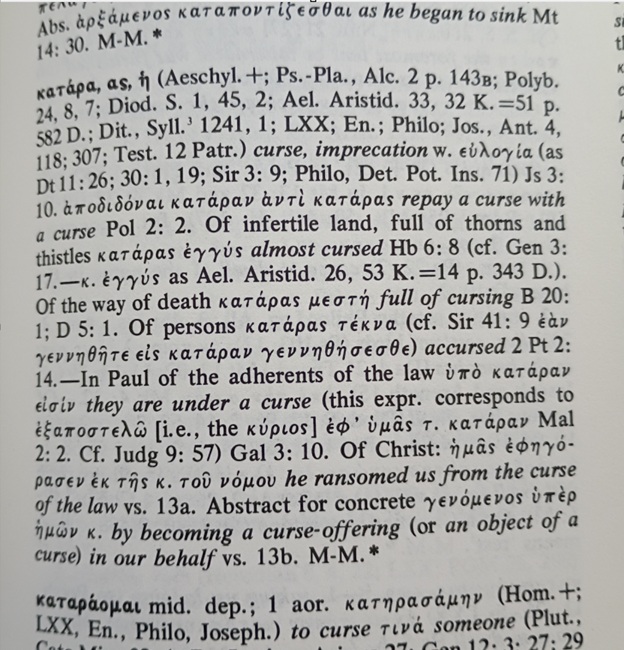
And here’s the text version of the relevant part of the quote. (The last ~20% of the definition.)
Gal 3: 10. Of Christ: ήμας έφηγό-ρασεν έκ τής κ. του νόμου he ransomed us from the curse of the law vs. 13a. Abstract for concrete γενόμενος ύπέρ huov K. by becoming a curse-offering (or an object of a curse) in our behalf vs. 13b. M-M .*
Thus, we have Thayer’s and BDAG which both present the same basic alternative to the PSA claim, though they word it slightly differently:
- BDAG: by becoming a curse-offering (or an object of a curse) in our behalf
- Thayer’s: one in whom the curse is exhibited, i. e. undergoing the appointed penalty of cursing
Same basic idea, different phrasing.
The word’s most respected lexicon, and also Thayer’s lexicon agree perfectly on what the word means in the specific context of Galatians 3:13: It means the “object of a curse”; i.e. the person suffering under the curse.
Thus, if we follow Thayer’s and BDAG, what we get is something like the following:
Galatians 3:13 (modified)
13 Christ redeemed us from the curse of the Law, having become [the] object/target of a curse for us—for it is written, “CURSED IS EVERYONE WHO HANGS ON A TREE”—
Now, the phrase “having become” is a single word in Greek, specifically a Greek participle. (Which you can confirm here; simply hover your cursor over the parsing under the word on a desktop, but you’ll have to use the parsing guide on mobile.) Greek participles can have multiple functions, and one of them is to indicate the means by which something is accomplished:
c) Means (Instrumental)
Identifying the means or agent by which an action of the main verb is accomplished = “by means of”
An instrumental participle will usually follow the main verbSource. (You can see the other uses of a Greek participle at that link as well.)
Thus, while there are other options, I think the most obvious understanding of the passage is the following:
Galatians 3:13 (modified)
13 Christ redeemed us from the curse of the Law [by] having become [the] object of a curse for us—for it is written, “CURSED IS EVERYONE WHO HANGS ON A TREE”—
I doubt that anyone will object to the insertion of the “by” there to indicate means. Someone might, but I don’t think that anyone has. Someone might object to the “object of a curse” language, but that’s straight from the lexicon.
I would like to reiterate that this understanding has strong lexical support; it’s not just me.
You saw the lexical quotes yourself. You might disagree, and that’s fine. However, I got this translation straight out of the Gold Standard, most respected Greek lexicon in the world. Thus, anyone who objects to that translation should at least concede that it’s a legitimate translation option.
Now, let’s move on to the last point to cover in this article before we put everything together.
What is a curse? (or a blessing?)
As usual, we’ll start with the lexical definition. We’ve already looked at the lexicon definition of the word in Galatians 3:13 (κατάρα/katára), so now we’ll look at the Hebrew word in Deuteronomy 21:23. (where it says: “for he who is hanged is accursed of God”)
קלָלָה (qelalah) designates a spoken malediction that places an individual, a community, or an object under divine or human disfavor. It stands in deliberate contrast to “blessing” (בְּרָכָה), appearing almost exclusively in paired formulations that press the covenant listener to choose life or death. Approximately thirty-three occurrences stretch from Genesis to Malachi, showing remarkable thematic unity: a curse is never a mere string of hostile words; it is a juridical pronouncement whose fulfillment rests ultimately in the hands of the LORD.
Ultimately, the curses and blessings in the Bible indicate a spoken word that produces a positive or negative effect. For curses, it’s a spoken word that produces a negative effect, and for blessings, it’s a positive word that produces a positive effect. This can easily be confirmed by the biblical usage.
For example, here’s the first use of blessing in the Bible.
Genesis 1:21-23
21 God created the great sea monsters and every living creature that moves, with which the waters swarmed after their kind, and every winged bird after its kind; and God saw that it was good. 22 God blessed them, saying, “Be fruitful and multiply, and fill the waters in the seas, and let birds multiply on the earth.” 23 There was evening and there was morning, a fifth day.
Ever since then, those creatures have multiplied on the Earth until they fulfilled the blessing put on them to fill the waters and seas, and birds did the same on the Earth.
And just a few verses later:
Genesis 1:27-28
27 God created man in His own image, in the image of God He created him; male and female He created them. 28 God blessed them; and God said to them, “Be fruitful and multiply, and fill the earth, and subdue it; and rule over the fish of the sea and over the birds of the sky and over every living thing that moves on the earth.”
Ever since then, mankind has been multiplying on the Earth and filling it with people. We’ve also ruled over every animal on the planet, and none has overtaken man as the dominant life form.
A blessing is a positive spoken word intended to bring about a positive result in the future.
Curses are the opposite.
Here’s the first place that a curse appears in the Bible, and notably, the curse isn’t on mankind, but rather the serpent right after the fall.
Genesis 3:14
14 The LORD God said to the serpent,
“Because you have done this,
Cursed are you more than all cattle,
And more than every beast of the field;
On your belly you will go,
And dust you will eat
All the days of your life;
And the next curse is only a few verses later.
Genesis 3:17-20
17 Then to Adam He said, “Because you have listened to the voice of your wife, and have eaten from the tree about which I commanded you, saying, ‘You shall not eat from it’;
Cursed is the ground because of you;
In toil you will eat of it
All the days of your life.18 “Both thorns and thistles it shall grow for you;
And you will eat the plants of the field;19 By the sweat of your face
You will eat bread,
Till you return to the ground,
Because from it you were taken;
For you are dust,
And to dust you shall return.”
Notice two things: (1) the curse wasn’t on Adam directly, but rather on the ground because of Adam. (2) This is still the case today, as any farmer can attest. God’s curse on the ground resulted in negative effects on the ground.
The next relevant curse is during God’s promise to Abram. (Abraham before he had his name changed.)
Genesis 12:1-3
1 Now the LORD said to Abram,
“Go forth from your country,
And from your relatives
And from your father’s house,
To the land which I will show you;2 And I will make you a great nation,
And I will bless you,
And make your name great;
And so you shall be a blessing;3 And I will bless those who bless you,
And the one who curses you I will curse.
And in you all the families of the earth will be blessed.”
Notably, the Hebrew word used here is the verb form of the noun used in Deuteronomy 21:23. These uses are pretty clear:
- A “curse” means something spoken that produces negative results for someone
- A “blessing” means something spoken that produces positive results for someone.
This is how we use the word even today. For example, someone who’s had a lot of bad things happen to him lately might say: “I’m cursed”. He might also say the same thing if he repeatedly tried something that should have worked, but it didn’t. In fantasy stories, a curse put on someone always causes bad things to happen.
A curse is a negative spoken word intended to bring about a negative result in the future.
This is effectively undisputed, and modern dictionaries define it similarly:
1: a prayer or invocation for harm or injury to come upon one : IMPRECATION
People believe that there is a curse on the house.2: a profane or obscene oath or word
In an antechamber, his lieutenants suddenly heard the shattering of glass and angry curses.
—Sam Moses3: something that is cursed or accursed
“I … will make this city a curse to all the nations of the earth.”
—Jeremiah 26:6 (King James Version)4: evil or misfortune that comes as if in response to imprecation or as retribution
… intolerance is the greatest curse of every land …
—Kenneth Roberts5: a cause of great harm or misfortune : TORMENT
His fame turned out to be a curse, not a blessing.
Please notice definition #3 above because it sounds exactly like the lexical quotes we’ve already seen.
Now, PSA says that Jesus became a literal curse on the cross vicariously in our place as our substitute, but does that make sense?
Did Jesus become “a negative spoken word intended to bring about a negative result in the future” on the cross as PSA says?
What would that even mean? To me, it seems utterly nonsensical. By contrast, saying that Jesus became the “object of a curse” makes perfect sense. He was affected by a curse, and He certainly did suffer a “negative result” on the cross.
(It’s also notable that curses which aren’t from God don’t always land. Proverbs 26:2 says: “Like a sparrow in its flitting, like a swallow in its flying, So a curse without cause does not alight.”)
Was Jesus cursed by God?
My patrons are always amazing, but sometimes they’re extra amazing. After I originally posted this article, one of my patrons disagreed with the conclusion and shared a scholarly paper arguing for a different understanding. (You can read that paper here if you like, but once I knew where to look, I was able to find a lot more evidence than the paper presents.)
This section has replaced the original conclusion of this article. (If you want to see the original conclusion, I’ve enclosed it in some expand/collapse navigation at the end of this section.)
There are two parts to this; one involves Hebrew grammar, the second is the Old Testament biblical context. We’ll look at the Old Testament context first, then the Hebrew grammar afterward.
Old Testament context
Something that I hadn’t noticed before reading that scholarly paper: there are numerous examples of someone or something “becoming a curse” in the Old Testament. And when I say “numerous”, I don’t mean 2-3, I mean more.
A lot more.
However, it’s a specific type of curse, in the style of: “let them be like ___” and similar phrasing, where the blank is something bad. This is actually a common formula for curses in the Bible, and here are some examples:
Psalm 35:5: Let them be like chaff before the wind, With the angel of the LORD driving them on.
Psalm 58:8: Let them be as a snail which melts away as it goes along, Like the miscarriages of a woman which never see the sun
Psalm 83:11: Make their nobles like Oreb and Zeeb And all their princes like Zebah and Zalmunna, (They were slain by Israel during the conquest of the holy land.)
Psalm 83:13: O my God, make them like the whirling dust, Like chaff before the wind.
Psalm 129:6: Let them be like grass upon the housetops, Which withers before it grows up
Again, the “let them be like ___” phrasing is a common, recognized type of curse in the Bible. With that context, we’ll look at the first and clearest verse that’ll lend context to how Jesus “became a curse” in Galatians 3:13.
Jeremiah 29:15-23
15 “Because you have said, ‘The LORD has raised up prophets for us in Babylon’— 16 for thus says the LORD concerning the king who sits on the throne of David, and concerning all the people who dwell in this city, your brothers who did not go with you into exile— 17 thus says the LORD of hosts, ‘Behold, I am sending upon them the sword, famine and pestilence, and I will make them like split-open figs that cannot be eaten due to rottenness. 18 ‘I will pursue them with the sword, with famine and with pestilence; and I will make them a terror to all the kingdoms of the earth, to be a curse and a horror and a hissing, and a reproach among all the nations where I have driven them, 19 because they have not listened to My words,’ declares the LORD, ‘which I sent to them again and again by My servants the prophets; but you did not listen,’ declares the LORD. 20 “You, therefore, hear the word of the LORD, all you exiles, whom I have sent away from Jerusalem to Babylon.
21 “Thus says the LORD of hosts, the God of Israel, concerning Ahab the son of Kolaiah and concerning Zedekiah the son of Maaseiah, who are prophesying to you falsely in My name, ‘Behold, I will deliver them into the hand of Nebuchadnezzar king of Babylon, and he will slay them before your eyes. 22 ‘Because of them a curse will be used by all the exiles from Judah who are in Babylon, saying, “May the LORD make you like Zedekiah and like Ahab, whom the king of Babylon roasted in the fire, 23 because they have acted foolishly in Israel, and have committed adultery with their neighbors’ wives and have spoken words in My name falsely, which I did not command them; and I am He who knows and am a witness,” declares the LORD.’”
That’s how someone “becomes a curse” according to the Old Testament: by being used as a curse as in the passage above:
“May the Lord make you like ___”
Obviously that can be phrased different ways, as we’ve already seen, and here’s another one:
“May what happened to ___ also happen to you.”
That turns a person and/or his name into a curse.
Again, there are many, many more examples of this. Importantly, many of them are from Jeremiah. Please keep that in mind because we’ll come back to it in a moment.
Jeremiah 24:8-10
8 ‘But like the bad figs which cannot be eaten due to rottenness—indeed, thus says the LORD—so I will abandon Zedekiah king of Judah and his officials, and the remnant of Jerusalem who remain in this land and the ones who dwell in the land of Egypt. 9 ‘I will make them a terror and an evil for all the kingdoms of the earth, as a reproach and a proverb, a taunt and a curse in all places where I will scatter them. 10 ‘I will send the sword, the famine and the pestilence upon them until they are destroyed from the land which I gave to them and their forefathers.’”
Jeremiah 25:18
17 Then I took the cup from the LORD’S hand and made all the nations to whom the LORD sent me drink it: 18 Jerusalem and the cities of Judah and its kings and its princes, to make them a ruin, a horror, a hissing and a curse, as it is this day;
Jeremiah 26:4-6
4 “And you will say to them, ‘Thus says the LORD, “If you will not listen to Me, to walk in My law which I have set before you, 5 to listen to the words of My servants the prophets, whom I have been sending to you again and again, but you have not listened; 6 then I will make this house like Shiloh, and this city I will make a curse to all the nations of the earth.”’”
Jeremiah 42:18
For thus says the LORD of hosts, the God of Israel, “As My anger and wrath have been poured out on the inhabitants of Jerusalem, so My wrath will be poured out on you when you enter Egypt. And you will become a curse, an object of horror, an imprecation and a reproach; and you will see this place no more.”
Jeremiah 44:7-8
7 ‘Now then thus says the LORD God of hosts, the God of Israel, “Why are you doing great harm to yourselves, so as to cut off from you man and woman, child and infant, from among Judah, leaving yourselves without remnant, 8 provoking Me to anger with the works of your hands, burning sacrifices to other gods in the land of Egypt, where you are entering to reside, so that you might be cut off and become a curse and a reproach among all the nations of the earth?
And a few verses later:
Jeremiah 44:11-13
11 “Therefore thus says the LORD of hosts, the God of Israel, ‘Behold, I am going to set My face against you for woe, even to cut off all Judah. 12 ‘And I will take away the remnant of Judah who have set their mind on entering the land of Egypt to reside there, and they will all meet their end in the land of Egypt; they will fall by the sword and meet their end by famine. Both small and great will die by the sword and famine; and they will become a curse, an object of horror, an imprecation and a reproach. 13 ‘And I will punish those who live in the land of Egypt, as I have punished Jerusalem, with the sword, with famine and with pestilence.
Jeremiah 44:22
22 “So the LORD was no longer able to endure it, because of the evil of your deeds, because of the abominations which you have committed; thus your land has become a ruin, an object of horror and a curse, without an inhabitant, as it is this day.
And one looking backwards in time to a point when Israel was a curse:
Zechariah 8:13
‘It will come about that just as you were a curse among the nations, O house of Judah and house of Israel, so I will save you that you may become a blessing. Do not fear; let your hands be strong.’
We also find this same kind of formula without the specific word “curse” being used.
1 Kings 9:7-8
7 then I will cut off Israel from the land which I have given them, and the house which I have consecrated for My name, I will cast out of My sight. So Israel will become a proverb and a byword among all peoples. 8 “And this house will become a heap of ruins; everyone who passes by will be astonished and hiss and say, ‘Why has the LORD done thus to this land and to this house?’
Ezekiel 5:14-15
14 ‘Moreover, I will make you a desolation and a reproach among the nations which surround you, in the sight of all who pass by. 15 ‘So it will be a reproach, a reviling, a warning and an object of horror to the nations who surround you when I execute judgments against you in anger, wrath and raging rebukes. I, the LORD, have spoken.
Deuteronomy 28:37 (part of what would happen if Israel broke their covenant)
37 “You shall become a horror, a proverb, and a taunt among all the people where the LORD drives you.
Isaiah 65:15 and 2 Chronicles 7:20 are similar, but I think the point has been beaten to death enough by now.
This is how God “makes someone a curse”.
Now, if we import this Old Testament context into the New Testament, Galatians 3:13 ends up looking quite a bit different. We’ll look at it in a moment, but first, we need to take a look at the Hebrew grammar of Deuteronomy 21:23, which Galatians references.
Hebrew Grammar; cursed without a verb?
Here’s how the passage is usually understood, and even translated, as exemplified by the ESV, and contrasted with the much better NASB 95:
Deuteronomy 21:23
ESV: his body shall not remain all night on the tree, but you shall bury him the same day, for a hanged man is cursed by God. You shall not defile your land that the LORD your God is giving you for an inheritance.
NASB 95: his corpse shall not hang all night on the tree, but you shall surely bury him on the same day (for he who is hanged is accursed of God), so that you do not defile your land which the LORD your God gives you as an inheritance.
Notice, “cursed by God” in the ESV versus: “accursed of God” in the NASB 95.
Here’s the important thing: there are no verbs in that phrase.
I took a screenshot of an interlinear, which demonstrates this, and you can see that below, or double check here. The red box is around the words we’re examining.
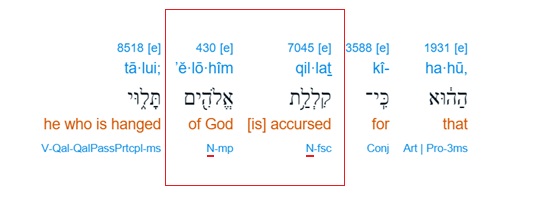
I somehow missed this when I originally published the article. For some reason, I didn’t notice that the word “curse” in Deuteronomy 21:23 is a noun, not a verb. That’s the difference between: “The witch cursed the tomb“, and “There is a curse on the tomb“. One is doing an action, the other describes a person, place, or thing.
Importantly, the ESV is wrong with “cursed by God” because it’s not a verb there.
(Though, it’s the ESV, so is anyone really surprised when it translates badly? Details in my article on Bible translations.)
As usual, the NASB 95 and NKJV are far better with “accursed of God”. The word “accursed” is an adjective meaning “being under or as if under a curse” (Webster’s). However, while an adjective is better than a verb, the ultimate meaning isn’t that different. However, there’s another way to understand it.
Remember what we just saw about how “becoming a curse” is used in the rest of the Old Testament.
Now, the Hebrew language likes to assume verbs of being (was, is, will be, being, etc.). With that bit of data, I think we can translate it properly, keeping both of them as nouns.
Deuteronomy 21:23 (modified)
NASB 95: his corpse shall not hang all night on the tree, but you shall surely bury him on the same day (for he who is hanged will be a curse of God), so that you do not defile your land which the LORD your God gives you as an inheritance.
Now, “will be a curse of God” is better, but not terribly clear. I would suggest the following translation to get the sense across more clearly.
Deuteronomy 21:23 (modified)
NASB 95: his corpse shall not hang all night on the tree, but you shall surely bury him on the same day (for he who is hanged will be a curse by God’s doing), so that you do not defile your land which the LORD your God gives you as an inheritance.
(The Hebrew construct relationship can indicate instrumentality, so “by” doesn’t need to be italicized. However, I didn’t want to make this article super long and boring by proving that, so italics it is.)
Is it perfect?
No.
Frankly, it’s still unclear without the context in the previous section. (A footnote would probably be the best way to tackle that in a Bible translation.) However, it makes it clear that “curse” is a noun, which is important. It also gets across the sense of the passage much better than “accursed of God”, partially because many people don’t know that “accursed” isn’t a verb, and they often think it’s a verb in the context of Deuteronomy 21:23. It’s certainly better than “cursed by God” that the ESV has.
Now, a little Greek grammar.
Greek Grammar; cursed without a verb?
Now, we need to take a closer look at Galatians 3:10 and 3:13. Specifically, we’ll be looking at the Greek word “ἐπικατάρατος” (epikataratos), which I’ve added so you can see where it’s used.
Galatians 3:10-14
10 For as many as are of the works of the Law are under a curse; for it is written, “CURSED (epikataratos) IS EVERYONE WHO DOES NOT ABIDE BY ALL THINGS WRITTEN IN THE BOOK OF THE LAW, TO PERFORM THEM.” 11 Now that no one is justified by the Law before God is evident; for, “THE RIGHTEOUS MAN SHALL LIVE BY FAITH.” 12 However, the Law is not of faith; on the contrary, “HE WHO PRACTICES THEM SHALL LIVE BY THEM.” 13 Christ redeemed us from the curse of the Law, having become a curse for us—for it is written, “CURSED (epikataratos) IS EVERYONE WHO HANGS ON A TREE”—14 in order that in Christ Jesus the blessing of Abraham might come to the Gentiles, so that we would receive the promise of the Spirit through faith.
Notably, epikataratos is an adjective, not a verb. The definition is what you’d expect, but important to make sure that we’re understanding scripture rightly.
Definition:
cursed, accursed; subject to the curse, of condemnation, Gal. 3:10; infamous, Gal. 3:13*
Thus, “epikataratos” refers to someone who has been cursed, and thus is “accursed”; i.e. under the effect of a curse.
Putting it all together
There are two datapoints that we must account for in this verse.
Galatians 3:13
13 Christ redeemed us from the curse of the Law, having become a curse for us—for it is written, “CURSED (epikataratos) IS EVERYONE WHO HANGS ON A TREE”—
The first datapoint is that Jesus “became a curse”, the second is that — according to the definition of “epikataratos” — Jesus must also have been cursed.
Now, datapoint #1 seems clear from what we saw above, that someone and/or his name can become a curse in the sense of “May what happened to ___ also happen to you“. Given how much Christians were persecuted, especially in the first few centuries, it’s extremely likely that someone said something like: “I hope you die like your precious Jesus did!” to a Christian many times in those first few centuries. In fact, it would fly in the face of reason and human nature to think it didn’t happen. Because it’s so likely, we’ll proceed like this is the proper understanding of “become a curse” when applied to Jesus.
The second datapoint is that — according to the definition of “epikataratos” — Jesus must also have been cursed. Here, PSA will likely wish to cry victory, but that might be premature. There is a way to understand this that doesn’t necessarily support PSA at all. (Actually there’s two, the second one being the previous conclusion of this article.)
How?
Because it’s a curse to become a curse.
If you scroll back up and read through those verses again, it’s clear that making Israel into a curse (i.e. “may what happened to Israel happen to you”) is part of the curse of the law. This becomes even clearer when you realize that most of those instances of Israel becoming a curse come from Jeremiah, who was a prophet both before and during the exile. The exile was, of course, a result of Israel continuously breaking their covenant over hundreds of years, bringing the curses upon them that God said would befall them if they broke the covenant.
That includes Israel becoming a curse, a reproach, a proverb, a taunt, a byword, etc.
Thus, the “curse” that was on Jesus is that His name became a curse. (Consider: how often do you hear people using Jesus’s name to curse these days?)
This makes perfect sense because of the Old Testament context, and that’s basically exactly what Galatians 3:13 says.
Galatians 3:13
13 Christ redeemed us from the curse of the Law, having become a curse (i.e. “May what happened to ___ happen to you”) for us—for it is written, “CURSED (by the fact that they — including Jesus — became a curse) IS EVERYONE WHO HANGS ON A TREE”—
This explains how Jesus can “become a curse” and also be “cursed” at the same time, harmonizing them perfectly. I do so love when everything harmonizes perfectly, because as Jesus says in John 10, “God’s word can’t be broken”.
(Note: You can click the text below to expand the original understanding of this article. It’s technically not wrong, and is still a valid way of looking at it, but it lacks all the Old Testament context that this understanding has. Thus, I recommend skipping it and going to the next heading.)
Click here to see the original understanding of this article. Was Jesus cursed by God? It’s extremely important that we don’t add to scripture, but it’s equally important that we don’t ignore what scripture says. Paul says this: Galatians 3:13 (modified) 13 Christ redeemed us from the curse of the Law, having become [the object of] a curse for us—for it is written, “CURSED IS EVERYONE WHO HANGS ON A TREE”— The Old Testament passage that Paul quotes does say that the person who hangs on a tree was cursed by God. Deuteronomy 21:22-23 22 “If a man has committed a sin worthy of death and he is put to death, and you hang him on a tree, 23 his corpse shall not hang all night on the tree, but you shall surely bury him on the same day (for he who is hanged is accursed of God), so that you do not defile your land which the LORD your God gives you as an inheritance. Now, notice the “if” clause. The actual command here isn’t about the death penalty, or giving someone the death penalty, but rather, it’s about what must be done with the corpse after the person is dead, but only if that person is “hung on a tree”. The command is that you don’t leave him on the tree overnight, but rather that you bury him the same day. Now, the verse does explicitly say that “he who is hanged is accursed of God”, and Paul references this verse and applies it to Jesus. The clear implication is that Jesus was cursed by God. Now, I suppose you could make an argument that it’s not explicitly stated, and so that’s not 100% certain. Some in the non-PSA camp will say that this just refers to Jesus being cursed by the men who saw him on the cross. Others will say it’s Jesus suffering the “curse” of mortality. Both are technically possible, but a careful reading of the text strongly leans in the direction that Jesus was indeed cursed by God… …which should be obvious to anyone who has read the account of the fall or Isaiah 53. Remember that a curse is: “a negative spoken word intended to bring about a negative result in the future“. Genesis 3:14-15 14 The LORD God said to the serpent, 15 And I will put enmity Virtually everyone agrees that this is the first prophecy about Christ, and it mentions Him getting bruised. (A negative result.) And in Isaiah 52: Isaiah 52:13-14 13 Behold, My servant will prosper, 14 Just as many were astonished at you, My people, Yes, those are prophecies. However, in some cases, the line between a curse from God and a negative prophecy from God can get a little fuzzy. In fact, God seems to deliberately conflate positive prophecy and blessing at one point. Jeremiah 18:7-10 7 “At one moment I might speak concerning a nation or concerning a kingdom to uproot, to pull down, or to destroy it; 8 if that nation against which I have spoken turns from its evil, I will relent concerning the calamity I planned to bring on it. 9 “Or at another moment I might speak concerning a nation or concerning a kingdom to build up or to plant it; 10 if it does evil in My sight by not obeying My voice, then I will think better of the good with which I had promised to bless it. Thus, it seems like there’s significant overlap between positive prophecy and blessings, at least some of the time. It follows logically then that there’s also significant overlap between negative prophecy and curses. So if we say that Jesus was “cursed by God”, that’s how I would understand it. I’ll admit that this isn’t perfectly satisfactory. Again, it’s important that we don’t add to the passage (as the PSA position does), and it’s equally important that we don’t ignore parts of the passage (as many non-PSA positions do.) When you include the Old Testament verse Paul was quoting, the clear implication is that Jesus was cursed by God. However, if we understand a curse as a spoken word from God about a negative result in the future, that seems to harmonize everything. Again, I’ll admit that I’m not perfectly satisfied with this answer. However, it would seem to respect the text and word definitions fully and completely. Since I’m unaware of another understanding that does that, I’ll hold to this understanding until I find something better. The PSA understanding makes gibberish of the text and the various non-PSA interpretations seem to ignore the clear implication of the text. I don’t think God inspired gibberish, and it seems foolhardy to ignore the clear implication. Thus, until I come to a better understanding, I would say that Jesus was “cursed by God” in the sense that God “spoke a negative word about Jesus intended to bring about a negative result in the future“… i.e. the cross. (And as a side-note, Genesis 3:8 says that Adam and Eve “heard the sound of the LORD God walking in the garden”, meaning that God was embodied at the time. I can make a solid argument that it was the pre-incarnate Christ speaking to Adam and Eve, which would mean that technically, He might’ve “cursed” Himself with the prophecy about the cross. Obviously that’s not certain, but it’s definitely possible.)
“Because you have done this,
Cursed are you more than all cattle,
And more than every beast of the field;
On your belly you will go,
And dust you will eat
All the days of your life;
Between you and the woman,
And between your seed and her seed;
He shall bruise you on the head,
And you shall bruise him on the heel.”
He will be high and lifted up and greatly exalted.
So His appearance was marred more than any man
And His form more than the sons of men.
Corrupting the incarnation?
We could’ve looked at this in the previous article, but I wanted to loop Galatians 3:13 into the discussion as well, so we’ll look at it here.
We’ll start with Hebrews:
Hebrews 9:13-14
13 For if the blood of goats and bulls and the ashes of a heifer sprinkling those who have been defiled sanctify for the cleansing of the flesh, 14 how much more will the blood of Christ, who through the eternal Spirit offered Himself without blemish to God, cleanse your conscience from dead works to serve the living God?
The Greek word translated “without blemish” is “ἄμωμος” (amomos), and it means exactly that:
299 ámōmos (an adjective, derived from 1 /A “not” and 3470 /mṓmos, “blemish”) – properly, unblemished, without spot or blot (blight); (figuratively) morally, spiritually blameless, unblemished from the marring effects of sin.
And the topical lexicon points out how this word was used in the Greek translation of the Old Testament, which is called the “Septuagint”.
In the Septuagint the term designates animals without defect brought to the altar (for example, Leviticus 1:3; Numbers 6:14). The sacrificial setting fixes the idea of complete purity—nothing outwardly marred and nothing inwardly corrupt. Every New Testament writer who employs the word draws on that background, moving from literal sacrifice to spiritual and moral integrity.
Notice that Jesus “offered Himself without blemish to God”, indicating that He was without blemish when He offered Himself, i.e., when He died.
Again, we need to read the text carefully.
Scripture states this elsewhere as well:
1 Peter 1:17-19
17 If you address as Father the One who impartially judges according to each one’s work, conduct yourselves in fear during the time of your stay on earth; 18 knowing that you were not redeemed with perishable things like silver or gold from your futile way of life inherited from your forefathers, 19 but with precious blood, as of a lamb unblemished and spotless, the blood of Christ.
Again, that’s clear.
It’s the explicit and unanimous testimony of scripture that Jesus was unblemished on the cross…
…but that’s not possible if He “became sin” and/or “became a curse” (in the sense of anathema) on the cross as many in the PSA camp insist.
Now, I realize that not all in the PSA camp will say that Jesus “became sin” and/or “became a curse” (in the sense of anathema) on the cross. Most who cite 2 Corinthians 5:21 or Galatians 3:13 to support PSA will say He did, but that’s not all of them. (Some say that Jesus was merely punished while remaining 100% pure/innocent, but that creates its own set of problems, and we’ll explore them soon.)
The most explicit modern statement of this comes from a sermon taught by the late Calvinist R.C. Sproul. We saw a fuller quote above, but here’s a smaller section of it to demonstrate the point.
What prevents us from seeing God is our heart, our impurity. But Jesus had no impurity. And Thomas said He was pure in heart. So obviously He had some, some experience of the beauty of the Father until that moment that my sin was placed upon Him. And the one who was pure was pure no more, and God cursed Him. It was as if there was a cry from heaven, excuse my language but I can be no more accurate than to say, it was as if Jesus heard the words, “God damn you.” Because that’s what it meant to be cursed, to be damned, to be under the anathema of the Father.
Source. (Starting at ~55:16)
That theology not only corrupts the incarnation, it also contradicts the explicit teaching of scripture. (As we saw above)
This leads to a problem for PSA.
Hebrews 9:14 (among other passages) make it explicitly clear that Jesus was “without blemish” on the cross. This means that 2 Corinthians 5:21 and Galatians 3:13 can’t be understood as making Jesus into sin and a curse (in the sense of anathema), because saying either makes Hebrews 9:14 false.
The problem is that PSA is now forced into a dilemma. Does it say that:
- Jesus became sin and a curse/anathema, ignoring Hebrews 9:14 (among other verses)
- Jesus became vicariously guilty for our sin, also ignoring Hebrews 9:14 (among other verses)
- Jesus remained 100% innocent on the cross, but God punished Him anyway
That last one avoids contradicting Hebrews 9:14, but leads to another problem.
Proverbs 6:16-19
16 There are six things which the LORD hates,
Yes, seven which are an abomination to Him:17 Haughty eyes, a lying tongue,
And hands that shed innocent blood,18 A heart that devises wicked plans,
Feet that run rapidly to evil,19 A false witness who utters lies,
And one who spreads strife among brothers.
Now, that doesn’t have to be a problem for Christianity overall because as we saw when we examined Isaiah 53:4, Jesus wasn’t “caused by God to be afflicted”. However, it most certainly is a problem for PSA. First, because if God didn’t cause Jesus’s death, then how could it be God punishing Jesus vicariously in our place as our substitute for our sin? Second, even if you can explain away Isaiah 53:4, you’re still stuck with God doing something that He explicitly says that He hates: shedding innocent blood. (Jesus’s)
Now, as you might’ve guessed, that’s far too much to tackle in this article.
We’ve examined Galatians 3:13, and that’s enough for now.
However, the next article will begin to examine PSA’s 3rd pillar, which is that it’s acceptable for God to punish an innocent substitute instead of the guilty person if a few conditions are met. (Like kind, sinlessness, and being voluntary.) We’ll start by looking to see if God ever punishes one person for another person’s sins in scripture, which will be the topic of the next article.
Conclusion
The passage isn’t about God’s wrath, it’s about the law. Galatians 3:13 isn’t about salvation, but rather, it’s about how God made becoming one of His people accessible to everyone. The law wasn’t required for salvation, it was a tutor to lead us to Christ, and it was also foreshadowing so we could see how Jesus would save us. Thus, Galatians 3:13 isn’t about salvation directly as PSA often claims.
There’s a difference between a normal curse and “anathema”. Anathema means cut off from God, and many in the PSA camp conflate the curse in Galatians 3:13 with anathema to say that Jesus was cut off from God on the cross. However, Scripture explicitly repudiates this idea, saying that anyone who calls Jesus anathema isn’t speaking by the Spirit.
Given those two facts, Galatians 3:13 does not support PSA.
A recognized way to curse someone in the Old Testament is: “May you become like ___”, where the blank is someone that had something terrible happen to him. This is how God makes someone into a curse in the Old Testament. Taking this context into Galatians 3:13, we see that Jesus “became a curse” in the sense of His name being used as a curse, in the vein of: “May what happened to Jesus happen to you.”
That’s how Jesus “became a curse”, which also doesn’t support PSA.
(Additionally, people use Jesus’s name to curse (swear/cuss) incessantly these days, which is worth noting.)
Looping in 2 Corinthians 5:21 with Galatians 3:13, if Jesus was made “into sin” and “became a curse” (in the sense of anathema), that would contradict Hebrews 9:14 and corrupt the incarnation itself. This leads to problems with God punishing a perfectly innocent person, which we will examine in the next article.
The next article will begin to examine PSA’s third pillar, which is that it’s acceptable to punish one man for another man’s sins as long as certain conditions are met. We’ll begin that study by looking at the passages that the PSA position puts forth which they say are examples of God doing exactly that.
I’ll see you there, and take care until then.
EDIT: That article is published, and you can read it here: PSA series — Did God Ever Punish the Innocent for the Sins of the Wicked in the Bible?
God Bless,
Berean Patriot




Coming of the Lord is near.